Creating Between Cultures A Conversation with Contemporary Artist Iryna Gragera
When the hot summer sun disappears beyond the horizon along Spain’s Costa del Sol, the atmosphere becomes softer and lighter, creating the perfect setting to slow down and open yourself to something a little more elevated, such as art.
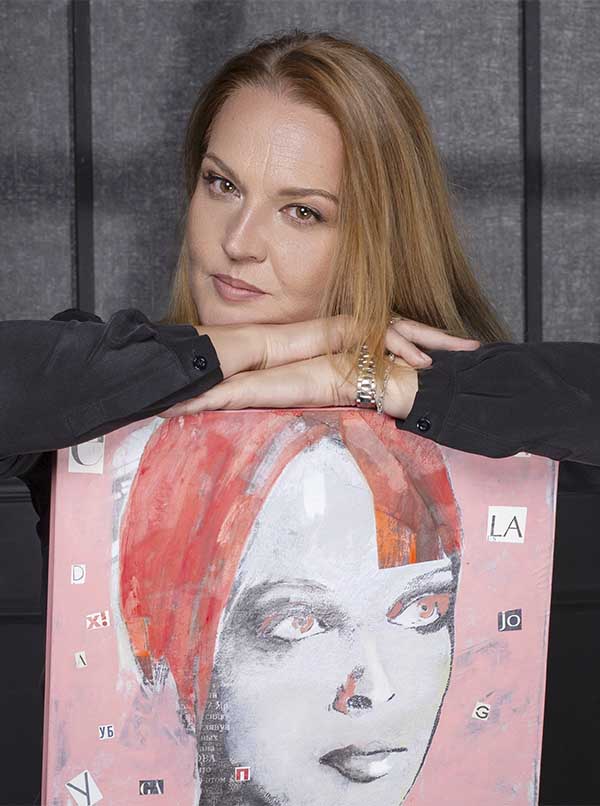
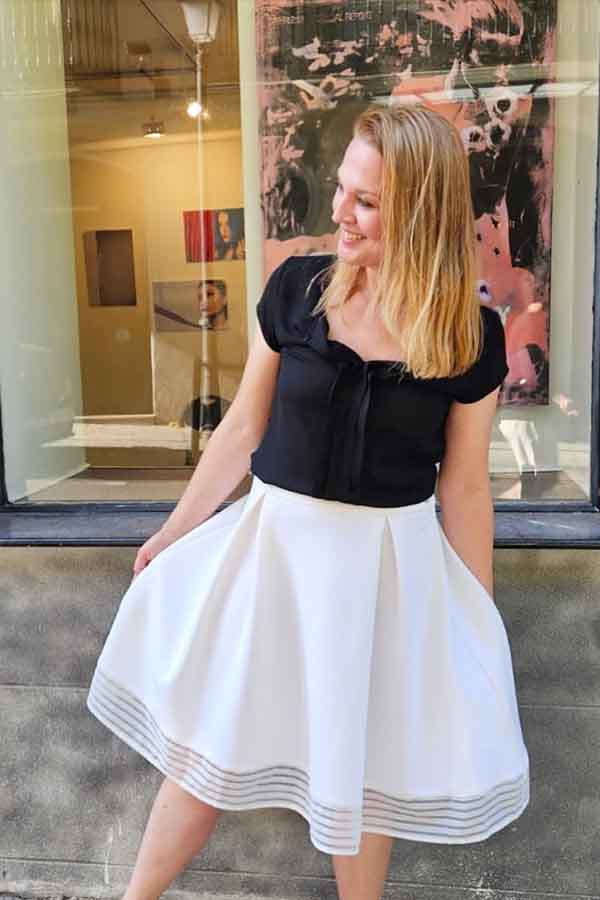
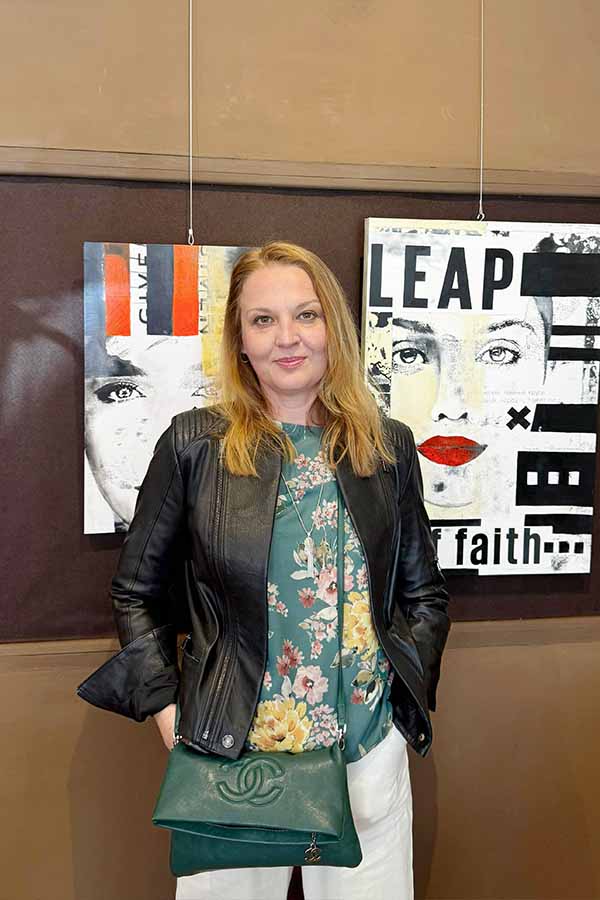
It was on one of those evenings that I met Iryna Gragera at the opening of the “Miradas” art exhibit at Metamorfosis Gallery of modern art in Marbella. She was one of the artists whose work had been selected for this vibrant exhibition, filled with different stories, perspectives, and ways of seeing the world.
Irina’s work immediately caught my attention, and our conversation continued long after the exhibition opening. What began as a conversation about contemporary art gradually turned into deeper conversations about life between cultures, something both of us have experienced extensively.
My own story of living between different countries and cultures you can find in “How traveling solo with a one-way ticket changed my life?” and “Living in Different Cultures Practical Lessons from Real Life”, but in this article, I wanted to turn the focus to Irina and her journey as a mixed media and contemporary artist with extensive experience of living in different cultures. We talk about her relationship with art, her creative process, and the experiences that have shaped the way she sees and creates.
I was especially happy when she agreed to continue our conversation in the form of an interview, approaching it with the openness and ease that seem to be such a natural part of her creative character.
Creating Between Cultures A Conversation with Contemporary Artist Iryna Gragera
Can you tell us a little about yourself and your journey as an artist?
I was born in Ukraine and had my first experience of moving to another country when I was four years old. Since then, I have lived in different places. I continue to paint wherever I live. For me, painting is a way of understanding myself and the world around me, and it also has something of a therapeutic process for me.
Every time I arrive in a new country, I have to build many things again. At first, nobody knows my work or knows me as an artist. Over the years, I gradually make connections, have art exhibitions, meet people, and receive feedback on my work. Then another move comes, and a new chapter begins.
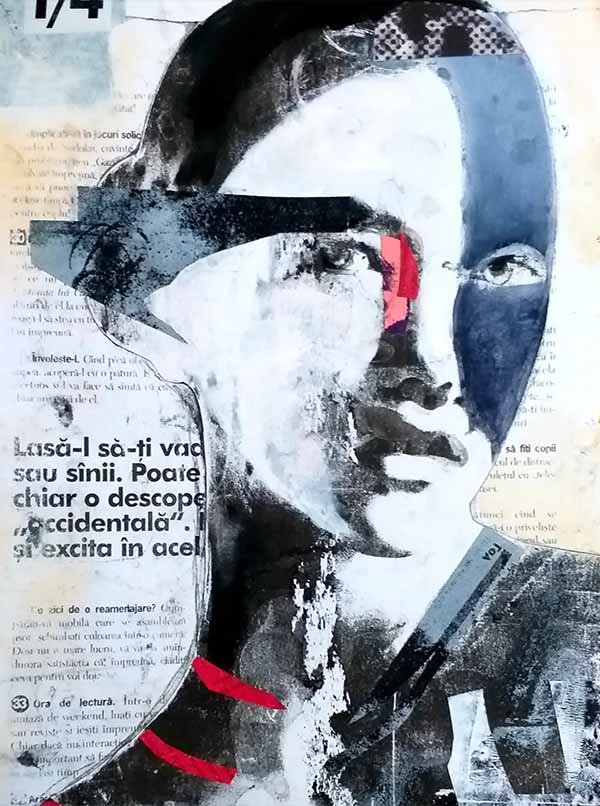
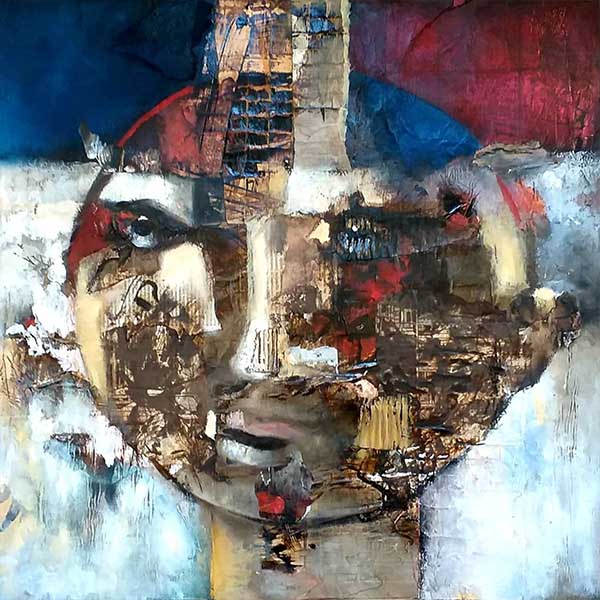
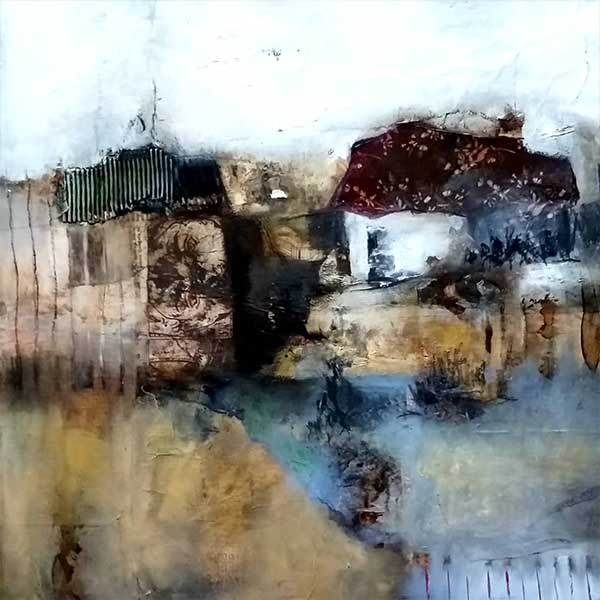
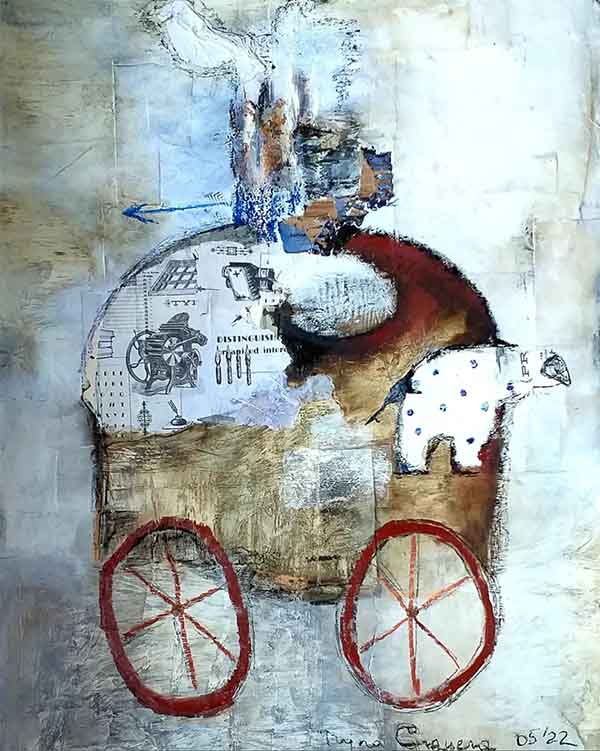
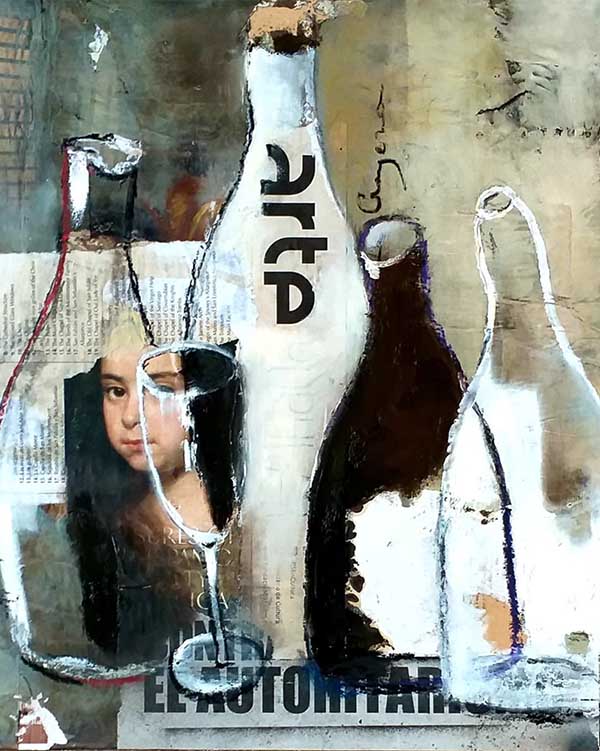
I would not say that I start completely from scratch, because I always carry my accumulated experience with me. It helps me a lot. In each place, some things in the way I paint change: the technique, the proportions, the colours. But one thing remains: I always work with layers and with fragments of different materials that I bring together on the canvas. This approach has also become an important part of my identity as a mixed media artist.
I often incorporate something personal or something connected to the place where I live: pages from my diaries, pages from my daughter’s school notebooks, pieces of newspapers or magazines, found materials. I think all these changes of place gradually shape the way I work and, little by little, my artistic language as a contemporary artist.
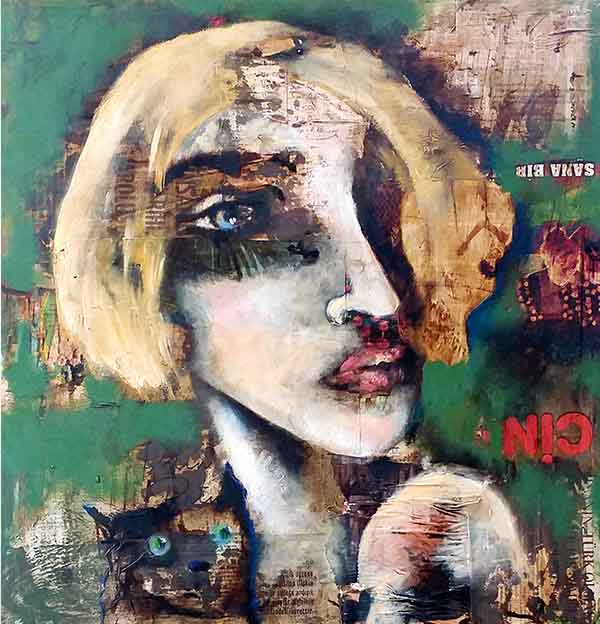
You’ve lived in several countries. Was there one moment when you realized you no longer belonged to just one place?
Some time ago, I started feeling uncomfortable with a very simple question: “Where are you from?” Not because I mind being asked, but because I no longer know what the answer is.
For a long time, I could simply say that I was from Ukraine, because I was born there. But after living in different countries, the question became more and more complicated.
In Ankara, I started answering that I was from Ankara. And the interesting thing is that I did not say it as a joke or ironically. I genuinely felt that I was from there. I had lived there for years, knew the city, had my own places, routines, relationships and a life I had built there.
Now, when I am in Madrid, I say that I am from Madrid. And I do not feel that this is a false answer either.
I think that was when I understood that perhaps I can be from more than one place. Not because I consciously decided to have several identities, but because my life has genuinely happened in different places, and each of them has somehow become part of me. I think that experience of living between cultures has also naturally influenced my perspective as a contemporary artist.
How has moving between cultures changed the way you see beauty, art, or everyday life?
There are many things that have affected me, but one of the strongest experiences was living in Colombia. There I understood magical realism in a completely different way. I realised that it was not simply something invented by writers, but that in many ways it was part of everyday life. I learned not to analyse everything or always look for an explanation or justification, but simply to observe and accept that things can be this way.
I was also fascinated by the relationship with plants and flowers. Many plants that we consider exotic, expensive or difficult to grow in Europe grow on the streets in Colombia and can be almost like weeds or even parasites. I remember seeing orchids growing on trees.
It changed the way I look at things. It made me think about how much our ideas of beauty, the exotic or even value depend on where we are looking from. Something extraordinary to one person can be completely ordinary to another. I think this way of looking at the world is also very close to what interests me in modern art, how the same thing can be perceived completely differently depending on the person and the place.
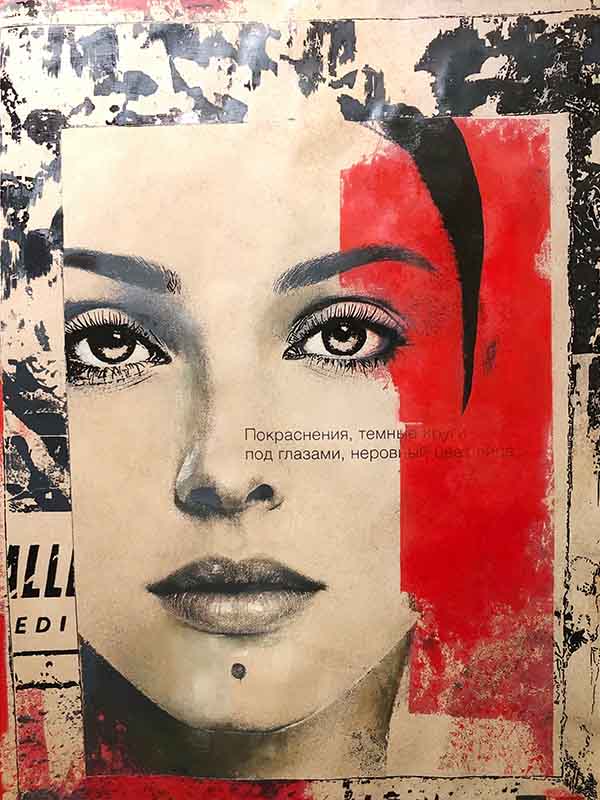
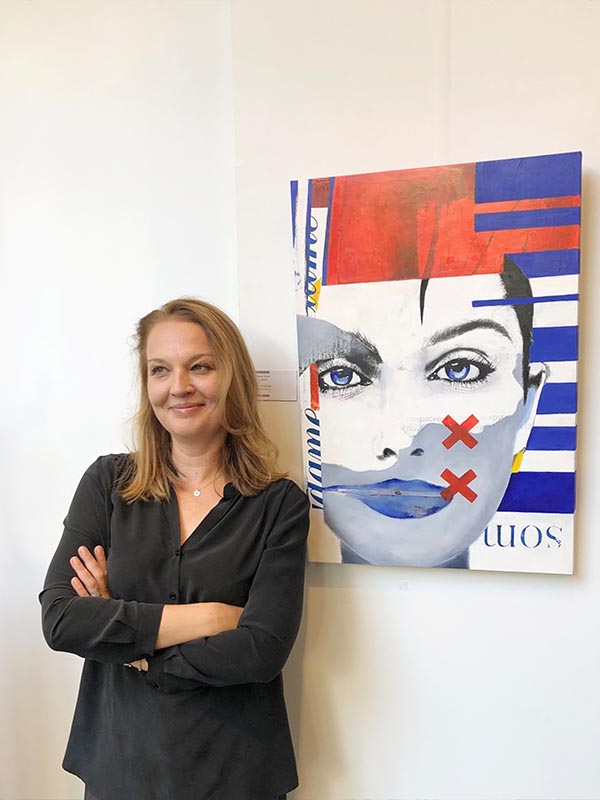
Has one country left a lasting mark on your artistic style or the way you create?
Each country leaves something in the way I work. When I move, my technique changes, the colours can change, and sometimes the proportions change as well. But I don’t usually leave these things behind when something new appears. I incorporate them into my work, and they become part of my creative process.
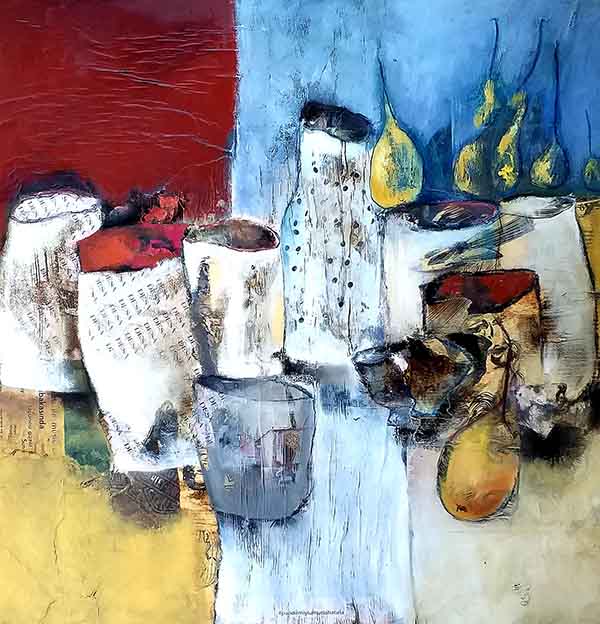
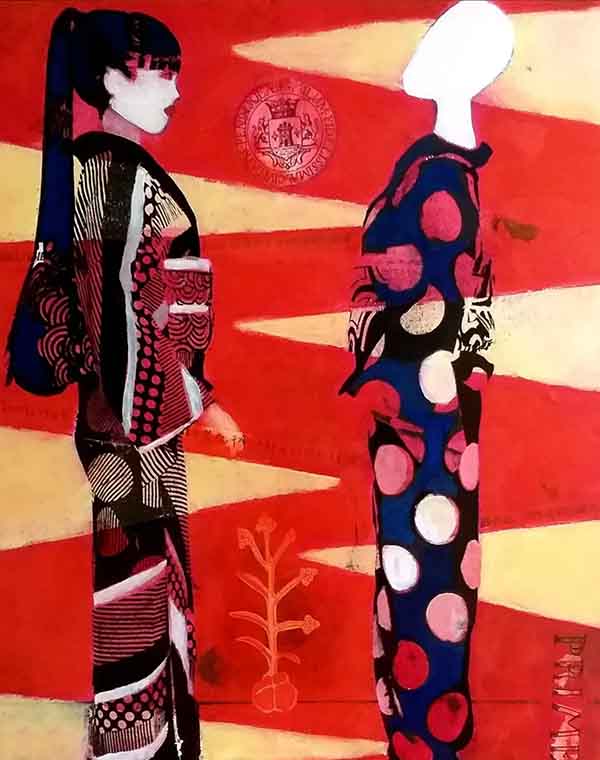
For example, in Turkey I used much more blue, while in Spain red has become a dominant colour. In Colombia, I started incorporating paper into my paintings.
At that time, I couldn’t find the oil paints from my usual brand, and I was making collages. When I finally got some paint, I started painting over the collages and really liked the result. I have continued using paper ever since. This is how my work gradually developed into a more mixed media approach, which has become an important part of my practice as a mixed media artist.
There was also an enormous amount of printed advertising material being produced and used for a very short time and then thrown away. In our building, every week they left piles of advertising that lasted a few days and then ended up in the rubbish. It made me sad to see so much paper being wasted. I thought about all the trees that had been used to produce it, and how strange it was to make something, use it for a few days and then simply throw it away.
So the material entered my work through a combination of circumstances: what I was doing at the time, what I had available, and what I was observing around me. What started almost by accident eventually became one of the elements that defines my contemporary art.
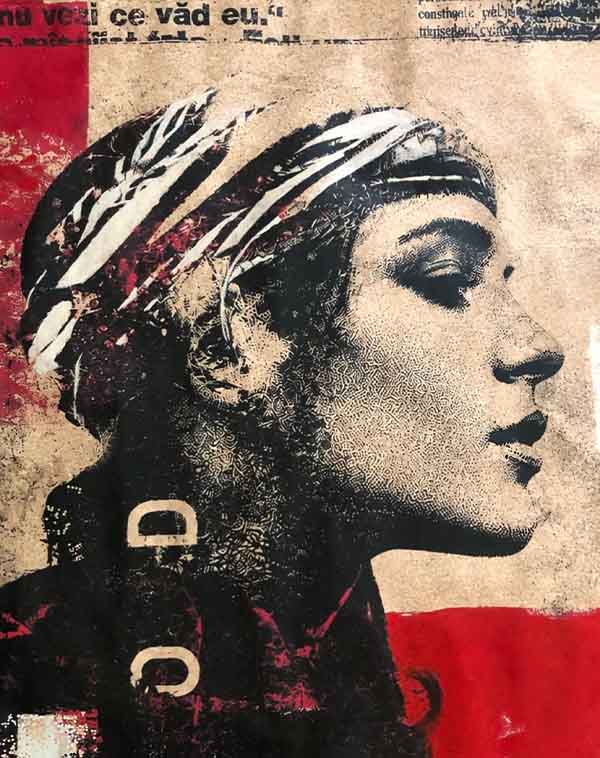
Many people imagine relocation as an exciting adventure, but they rarely talk about what is lost along the way. What have you had to let go of, and what have you gained?
Moving from one country to another means losing many small things that you sometimes only notice when they are no longer there. One of them is the ease of sharing a language and a culture. For example, humour changes a lot. There are jokes and references from Ukraine that I can share with someone from there without explaining anything, but they don’t work in quite the same way in Spain. And even when I speak another language, I never express myself exactly as I do in my mother tongue. The accent, the words and the way I construct a sentence also change the way I present myself to other people.
But at the same time, I have gained something that I value enormously. I have been able to experience different cultures from the inside, not as a tourist. I have lived their routines, relationships, ways of thinking and also their contradictions. I really value that experience.
I also think that living as a foreigner has helped me connect with people in a different way. My interest in people is genuine. I want to know them, and I think they can feel that. I am not so afraid of making a bad impression or making a mistake in a conversation, because I know that I am different and that there are things I may not know or understand. Mistakes are part of my experience and, in a way, they are also part of me.
I don’t need to pretend that I completely belong in order to connect with someone. Perhaps this openness to being between cultures has also become part of the way I see the world and, ultimately, part of who I am as a contemporary artist.
Do you think creativity grows when we step outside our comfort zone, or is that a romantic myth?
I’m not sure that creativity depends on stepping outside our comfort zone. For me, creating is simply part of everyday life. I paint, I write, I experiment with materials, and very often inspiration comes while I am working. There is a constant dialogue between the work and me, and sometimes I don’t know where the process will take me.
I also don’t see a direct connection between an experience and a painting. It doesn’t work for me as: “This impressed me, so I’m going to paint this emotion or this beauty.” Things that affect me, positively or negatively, can appear much later in my work.
First I need to process and absorb them. With time, some experiences become part of me, and only then can they appear in my work. That is why I often recognise the origin of something in a painting only after I have made it.
I don’t actively look for inspiration. I allow myself to receive what is around me: voices, colours, smells, textures, atmospheres, emotions. I don’t necessarily analyse these things at the moment. They stay somewhere inside me, and sometimes much later I recognise them in my work.
For me, creativity has more to do with receiving, experimenting and having a dialogue with the process than with constantly being outside my comfort zone. That openness to experimentation is also an important part of my approach to contemporary art.
How has living in Madrid influenced your work compared to the countries you’ve lived in before?
Madrid is probably the city that has had the strongest impact on me and has transformed me the most. I have lived here since 2022, although my relationship with Madrid started much earlier because I am married a man from Madrid and I have been part of this context for many years.
Spain has taught me a different way of understanding life. I really like the importance given to enjoying life, to food, to spending time together and to family. In other places where I have lived, I was more familiar with the idea of working, achieving goals and moving forward. Here I discovered that enjoying life can also be an important part of life itself.
I have been deeply affected by the culture, the richness of the language and, especially, flamenco. There is something deeply tragic and transcendent about it that moves me. I have also met people here who have helped me enormously without expecting anything in return.
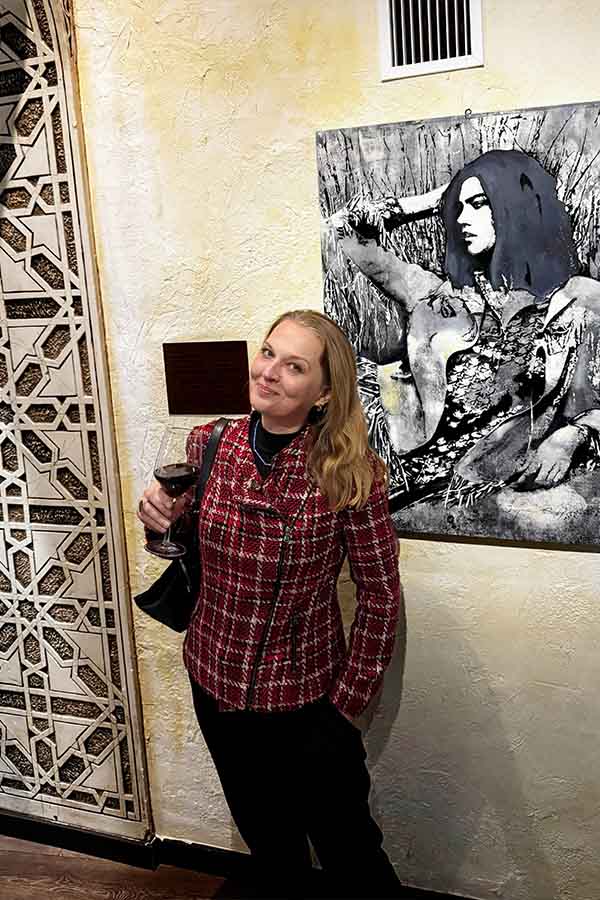
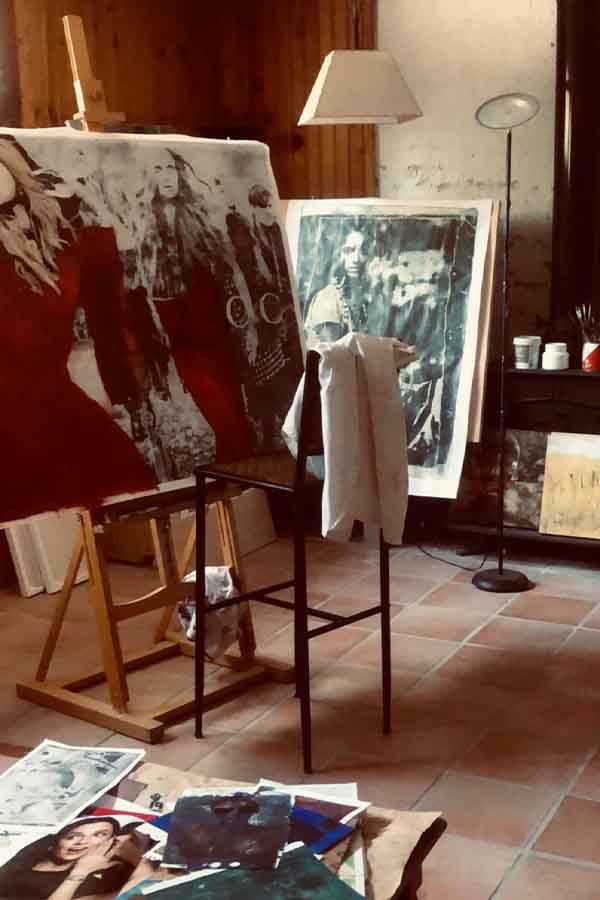
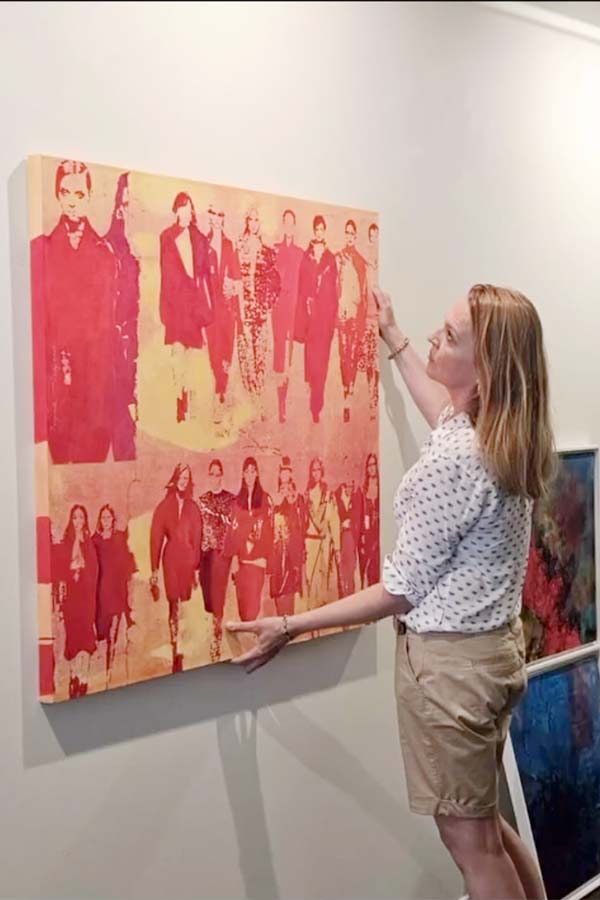
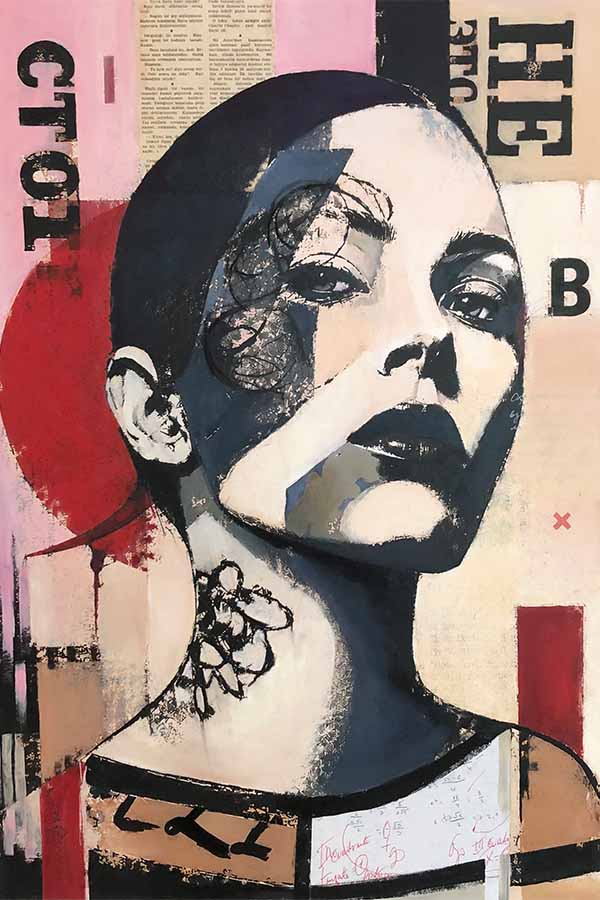
All of this has influenced my painting. My figures have changed quite a lot. They have become more intense and have a lot of energy. Some of them look a little like magazine covers. They look directly at you and seem to recognise their own value. They are not trying to impress or prove anything; they simply seem to say, “This is who I am.”
I don’t see them as proud or independent figures. They are still very connected to their surroundings and their context. It is more about accepting themselves as they are.
The colour has also changed a lot. Red has become the dominant colour. But I still work with layers and fragments, which are elements that have remained in my artistic language and continue to be important to my work as a mixed media artist.
There is a small story from my early days in Madrid that I still remember. In a bar, a bartender asked me something and my Spanish was still quite poor. I told him that I wasn’t from Madrid, and he replied: “If you’re in Madrid, you’re from Madrid.” I don’t even remember which bar it was, but I remember the sentence. I think it contains something I have understood better over time and something that has also become part of my perspective as a contemporary artist.
Was there a place, street, museum, café, or everyday ritual that made you feel, “I could build a life here”?
I don’t actually remember one specific moment or place that made me think that. I think it happened much more gradually, through an accumulation of everyday experiences.
I do remember the story about the bartender I mentioned before, although I don’t remember which bar it was. I find it meaningful because I was still learning Spanish, and yet he didn’t see being a foreigner as something that excluded me from Madrid.
Over time, Madrid became my home. But I wouldn’t say that I completely identify myself with the city. I feel good here and I feel that my life is here, but that doesn’t mean that Madrid has to become a definition of who I am.
Perhaps a home doesn’t necessarily have to be a place you completely identify yourself with. It can simply be the place where your life is happening now.
Looking back, is there one move you almost didn’t make but are now grateful you did?
Yes. After living in Cartagena de Indias, my husband and I were planning to return to Madrid. We felt that we had completed a chapter of our life abroad and that it was time to return to Spain.
Then my husband was offered another destination: Ankara, in Turkey. At first we were very close to turning it down. It wasn’t part of our plans, and we thought our experience of living abroad was coming to an end. But at the last moment, we decided to accept it.
And it turned out to be one of the best decisions we have made. I lived in Ankara for four years and, so far, it has been my favourite experience of living in another country. I loved the city, the culture and everyday life there. It was also a very important period for my artistic work as a contemporary artist and helped shape the way I create my art today.
Sometimes I think that if we had followed our original plan, we would simply have returned to Madrid, and that whole part of my life would never have happened.
If someone is dreaming of moving abroad but is afraid of leaving behind the familiar, what would you recommend to them?
I’m not sure I can give advice that would work for everyone. Each person will experience and process something like this in their own way.
But I think having an open mind is very important. When you arrive in another country, you discover that every culture has its own codes and rules, many of them are things that are completely natural to the people who live there. At first, they can seem strange or difficult to understand. You have to give yourself time to learn those codes. Once you start understanding them, life becomes easier and also much more interesting.
As a contemporary artist, I think this openness is especially important because living between different cultures constantly gives me new things to observe, question and eventually bring into my work.
And you have to be prepared to work quite hard. Moving to another country is not only about discovering a new culture or having an adventure. You have to build many things again: relationships, contacts, routines and a way of finding your place in everyday life. It takes time and effort. For me, that process of observing and adapting has become part of my artistic perspective and the way I approach modern art.
What does “home” mean to you today? Is it a place, the people you love, or something you’ve learned to carry within yourself?
For me, “home” means much more than the place where I live. It is a place where I feel comfortable and protected, where I know the spaces, the small details and how things work. It is a place that fits me in a deep way.
Madrid is my home now, but there is something else: the person I am in Madrid has also been created by Madrid. It is a version of me that has developed here and that fits this place.
At the same time, I don’t feel that my other homes disappear. I have lived in different places, and each one has left something in me. That is why I feel that I carry several homes within me.
Perhaps for me, home is not one single place. It is also the sum of the people, experiences and different versions of myself that I have built along the way.
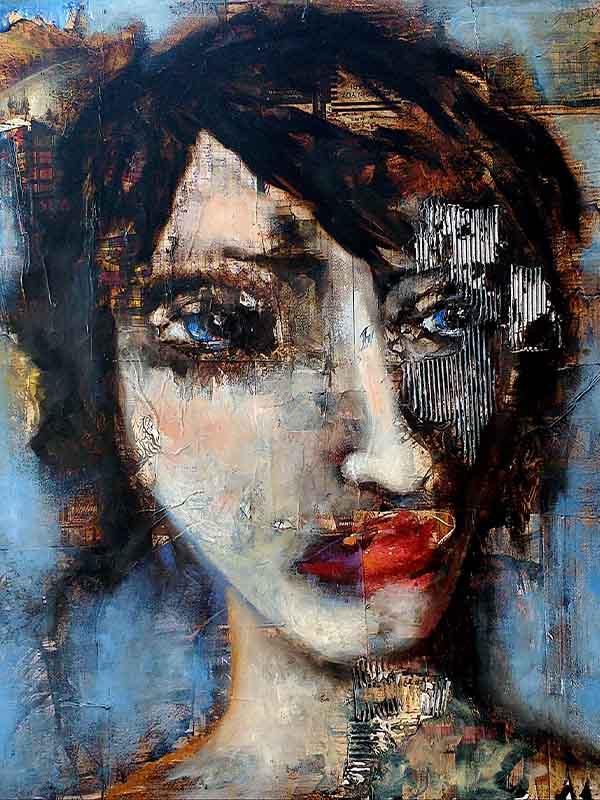
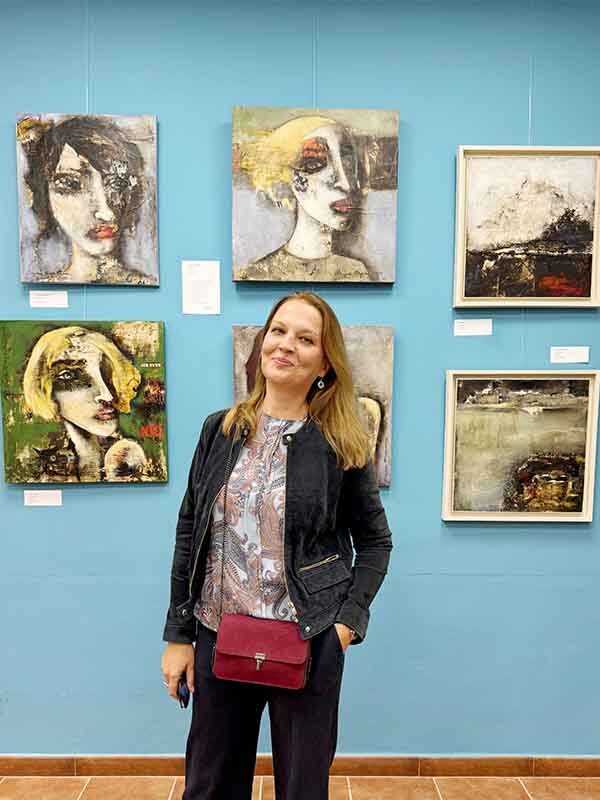
If someone who had never met you could only see one of your paintings, which one would you choose, and what story would you hope they discover within it?
I think I would choose El diario de mi amiga. It is connected to one of the things I observe most closely: our inner transformations.
I am interested in what happens inside us as we go through life, how experiences change us, how we react to those changes, and how, little by little, we try to understand them. I am more interested in observing what changes inside us. I think we are constantly creating stories about ourselves as we try to understand these transformations.
If someone could find their own story in this painting, rather than mine, I would really like that. I think a work on an art piece can begin with a very personal experience, but then it stops belonging entirely to the artist. Each person can recognise something different in it and create their own story around it. As a contemporary artist, I don’t think I need to give the viewer only one way to understand my work.
Learn more about Irina’s art on her Instagram page – Iryna Gragera
Talking to Iryna made me think once again about how much the places we live in become part of who we are. Her paintings seem to carry these experiences in layers: fragments of places, memories, emotions, and moments that gradually become something new.
Perhaps that is what makes her work so interesting to me. It is about where she has lived and also how those places have changed the way she sees, feels, and creates.
And what about you? If you could look at your own life as a painting, which places, people, and experiences would you see layered into it?
Where Do You Belong
Where in the World Would you feel most yourself? Find out which country matches your inner rhythm.

Elena Sullivan
Hi, there! I’m Elena Sullivan, a fine art photographer, and creative adventurer. My first joyful experimentation with a camera extended into a passionate relationship where harmony represents a constant flow of elegant devotion. I follow my intuition and curiosity in search of eternal connections in nature, then use my camera to reveal it and share it with you! Every of my photo is curated with love and artistic excellence.