• Home
  • About
  • Exhibitions
  • Shop
  • Gallery
  • Publications
  • Speaking
  • Blog
    • Main Blog Page
    • Interior Design
    • Style & Beauty
    • Art & Entertainment
    • Nostalgic & Vintage
    • Travel
    • Museums & Galleries
    • Food & Dining
    • Personal Stories
    • Guest Post
  • Contact
0

Fine Art photography, fine art photo prints, canvas, wall art, macro photography, Spain

Interior Design Monuments & Fountains Spain

Exploring Spain Through Its Iconic Ceramic Tiles Azulejos

February 27, 2026

What if I told you that some of the most beautiful stories of Spain aren’t in majestic palaces or museums but hiding in plain sight, on doorways, staircases, and walls?

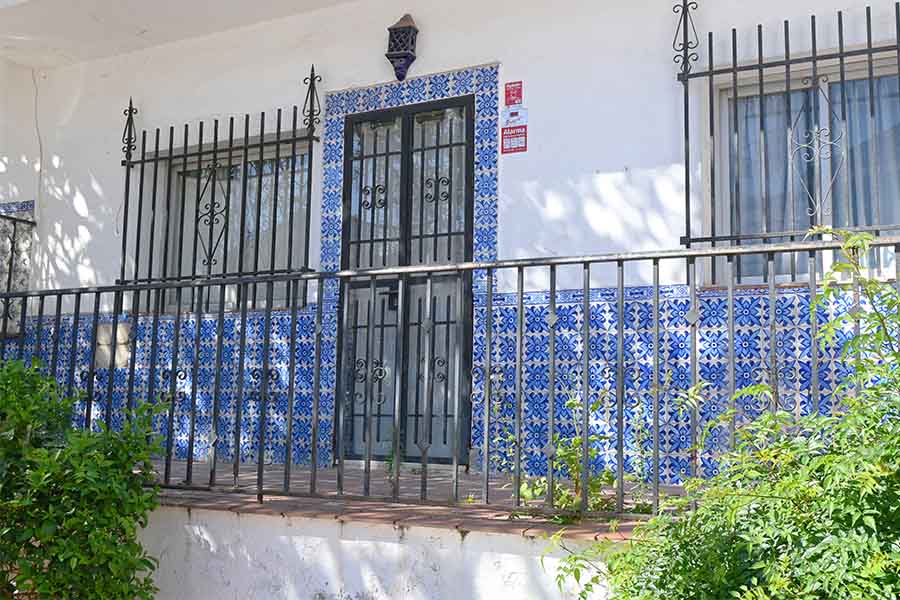
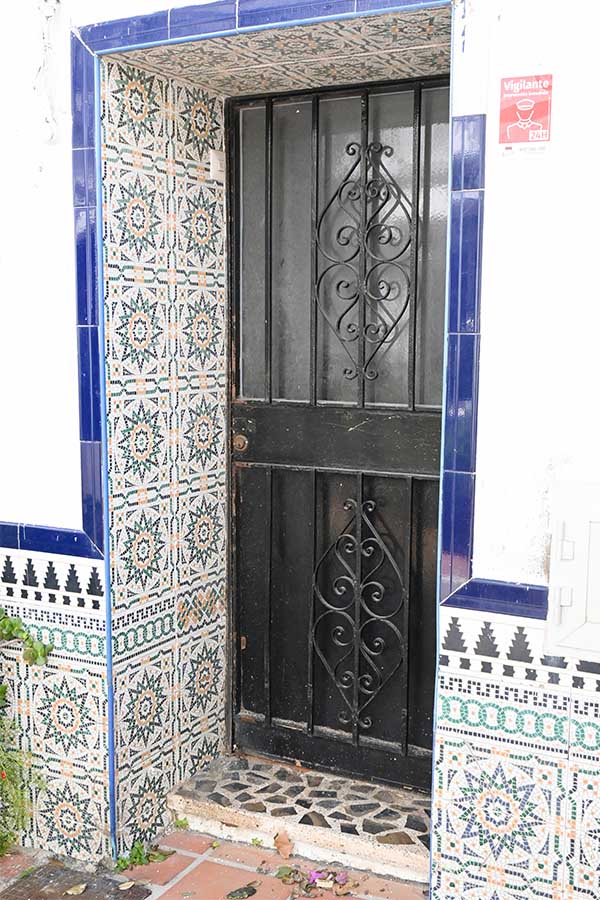
Traveling and exploring is about noticing little details that create a bigger picture. Walking through the streets of old towns like Marbella’s Casco Antiguo, you’ll notice decorative elements that elegantly add a personal touch to buildings. They appear around doorways, along stair edges, framing balconies, or lining walls. They are so present yet often overlooked, rarely promoted as points of interest. But if you look closely, spotting each tile can feel like a treasure hunt, a little prize hidden in the maze of streets.

These tiles are called azulejos, and they come in countless colorful designs: geometric patterns, floral motifs (like Peaceful Bloom), or intricate storytelling scenes. When you start paying attention to these small details, a city shifts from being a backdrop to becoming a story. It’s in a chipped azulejo by a doorway, a faded ceramic street sign, or an iron balcony casting patterned shadows in the afternoon light. Big landmarks impress, but small details pull you in. They slow you down, spark curiosity, and make walking the streets feel like a personal discovery. Even the quietest street suddenly feels alive.

Large-terrace-with-black-metal-railings-and-extensive-blue-and-white-floral-wall-tiling
Black-metal-doorway-framed-by-vibrant-geometric-tessellated-tiles-and-a-dark-blue-border
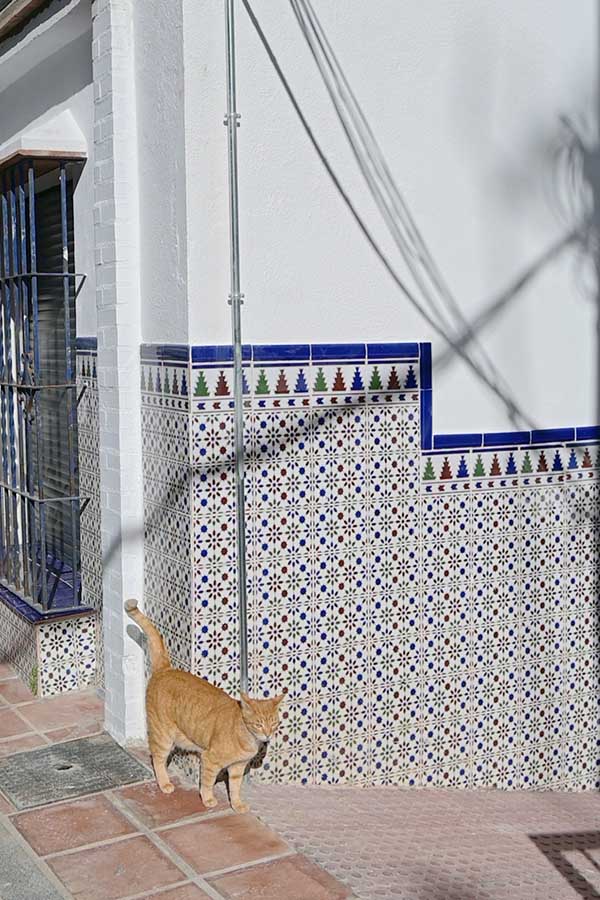
Ginger-cat-walking-past-a-white-wall-decorated-with-intricate-blue-and-red-geometric-tiles
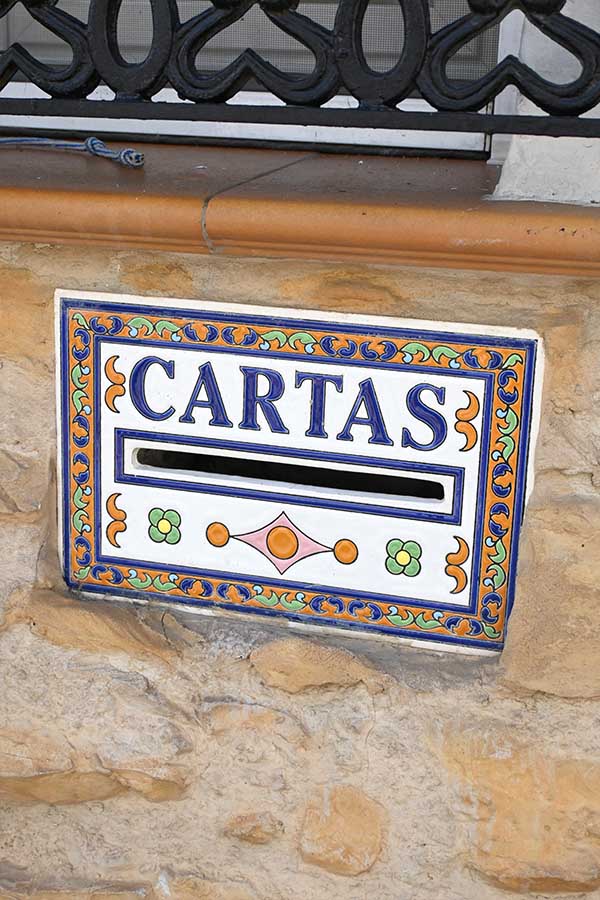
Ceramic-mail-slot-tile-with-the-word-CARTAS-set-into-a-stone-wall
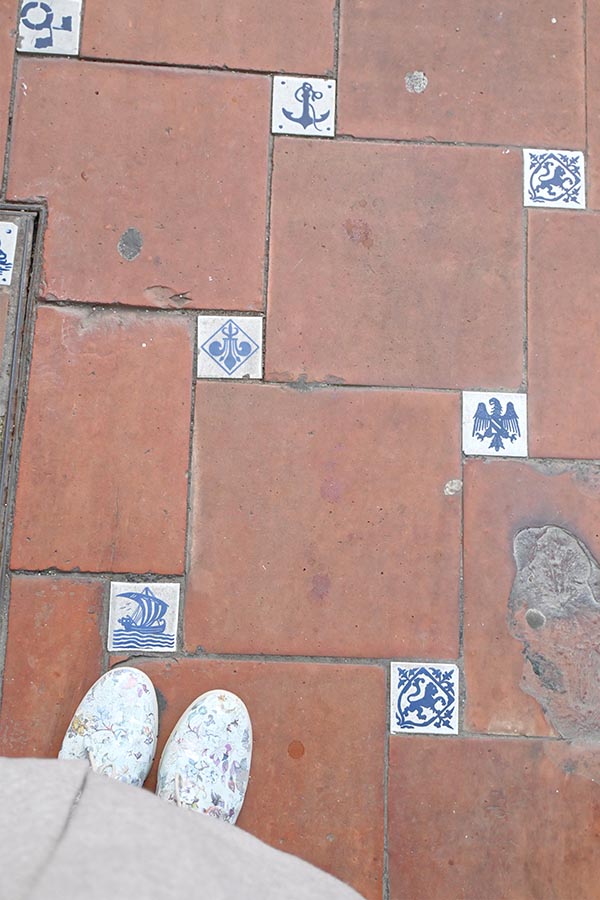
floor-tiles-accented-with-small-blue-and-white-decorative-tiles
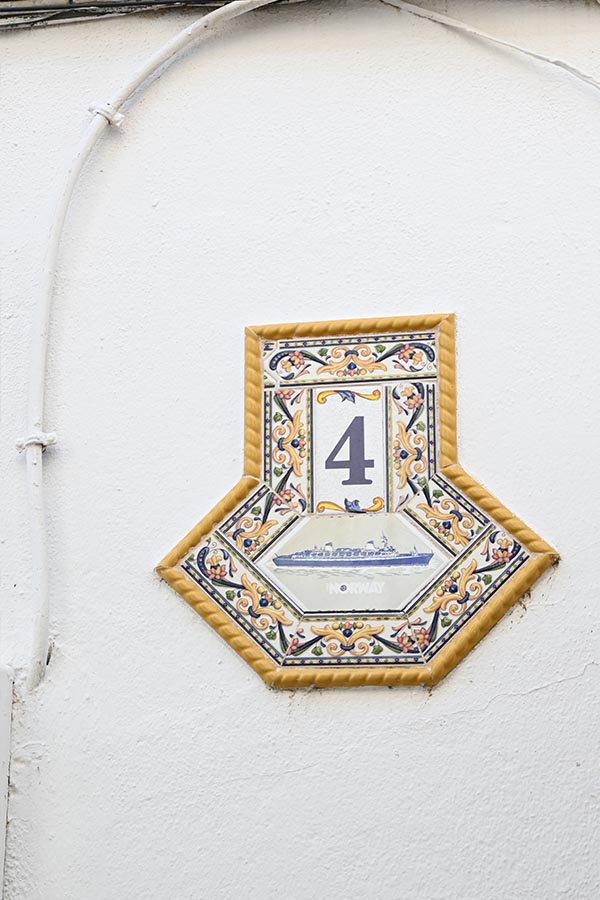
Decorative-ceramic-house-number-plaque-featuring-the-number-four-and-a-ship-on-a-white-wall

Where Did This Tile Tradition Begin?

Azulejo is the word used in Spain and Portugal for a glazed tile: a terracotta tile covered with an opaque glaze. The word comes from the Arabic al-zillīj, meaning “polished stone.” Its history stretches back to the centuries of Islamic presence on the Iberian Peninsula. Early tiles focused on intricate geometric mosaics, carefully cut and assembled into mesmerizing patterns. Some of the most stunning examples survive at the Alhambra.

When Christian kingdoms reclaimed southern Spain, the tradition evolved. Seville became a major production center from the 13th to the 16th centuries, blending Islamic design with Gothic and Renaissance influences. This fusion style is known as Mudéjar, and it gives Spanish azulejos their distinctive character. Walk through the Alcázar of Seville and you’ll see geometric Islamic patterns gradually mixing with figurative scenes and European decorative elements.

By the 16th century, Italian artists brought the majolica technique to Spain, allowing artists to paint detailed figurative scenes directly onto tiles: religious images, mythological stories, hunting scenes, and family crests. Tiles stopped being seen as mere patterned surfaces and became storytelling mediums. Cities like Talavera de la Reina and Valencia flourished as centers of tile production. Churches, monasteries, noble homes, and public buildings were richly decorated, with examples like the Basílica de Nuestra Señora del Prado showcasing vibrant tilework covering chapels and altars.

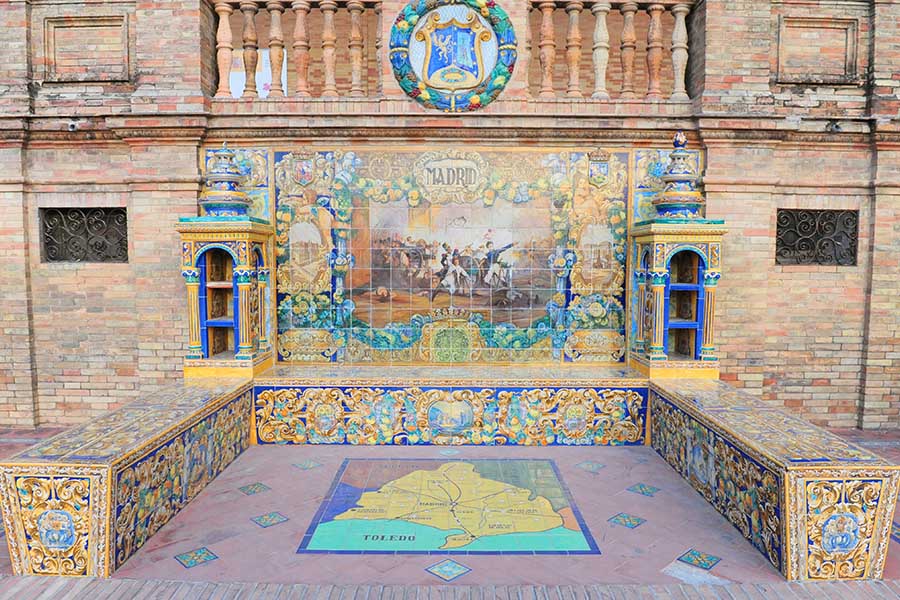
Ornate-ceramic-fountain-and-tiled-mural-set-into-a-brick-wall-with-a-balustrade-above
This is the Madrid Alcove at Seville's Plaza de España, specifically dedicated to Spain's capital. The central mural depicts the Dos de Mayo Uprising of 1808 (a revolt against Napoleon's troops), framed by ceramic "bookshelves" on the sides and a tiled map of the Madrid province on the floor. It is one of 48 such stations in the plaza, each celebrating a different Spanish province through traditional azulejo tilework
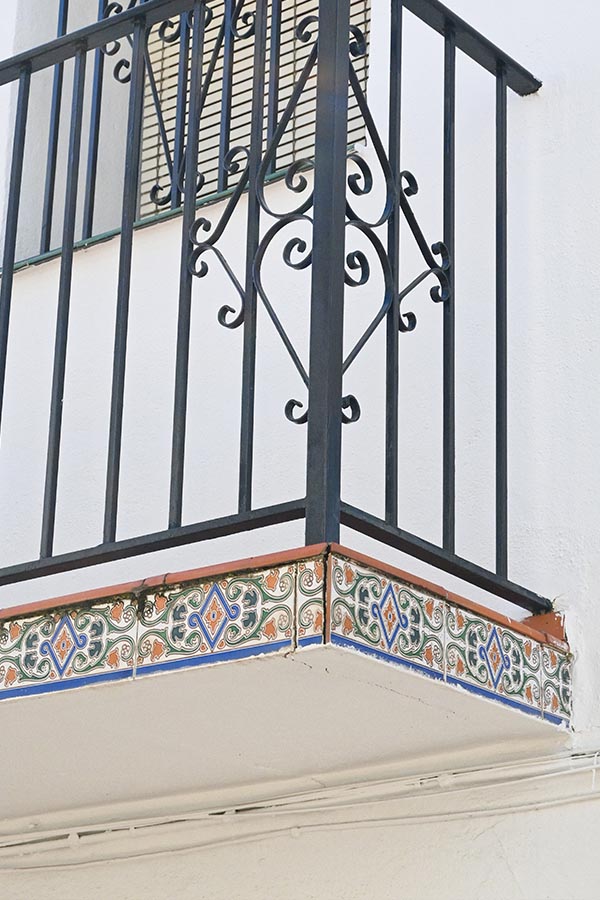
Small-balcony-with-black-wrought-iron-railings-and-decorative-ceramic-tiles-along-the-base
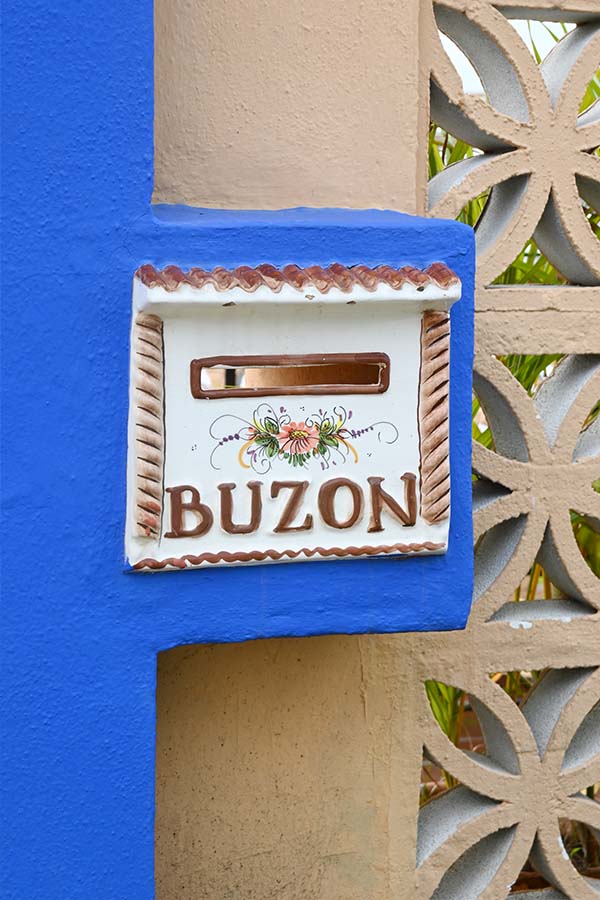
Hand-painted-ceramic-mailbox-with-the-word-BUZON-mounted-on-a-vibrant-blue-and-tan-wall

Azulejos Journey From Palaces to Everyday Homes

Originally, azulejos were reserved for royal palaces and major monuments as symbols of power, refinement, and wealth. But as techniques like cuerda seca and painted majolica made production faster and more affordable, tiles gradually moved into private homes. By the 16th and 17th centuries, wealthy merchants were decorating façades and doorways, signaling prosperity. Industrial production in the 19th century made them accessible even to modest houses, turning ordinary streets into open-air galleries and making beauty part of everyday life.

Tiles served a practical purpose as much as a decorative one. Ceramic surfaces kept walls cool under the Andalusian sun, protected entrances from wear, and were easy to clean. Unlike in Portugal, Spanish azulejos often retained a full palette of deep blues, greens, yellows, and earthy tones. Motifs ranged from floral designs to heraldic symbols and religious imagery, blending Islamic geometry, Christian symbolism, Renaissance elegance, and local craftsmanship, all layered into clay and glaze.

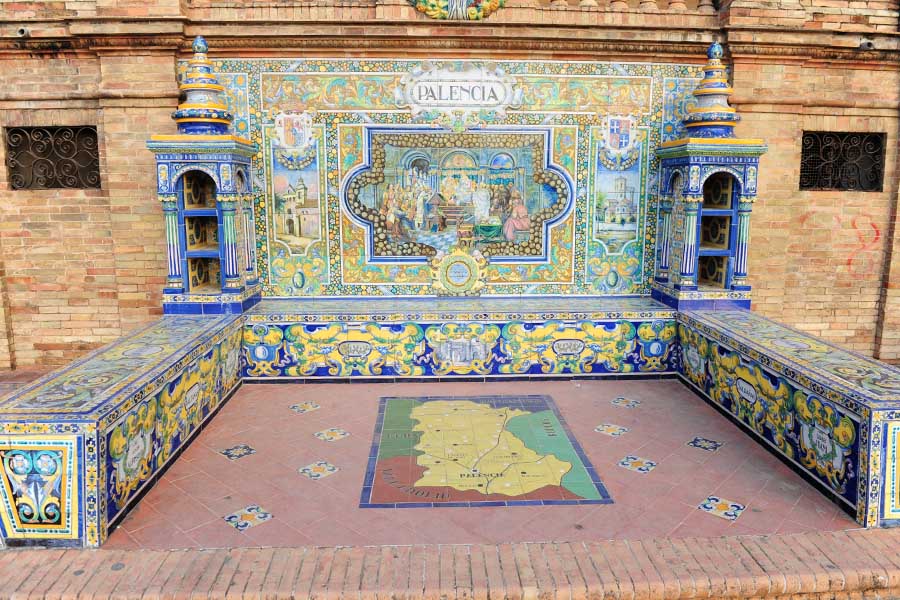
Ornate-tiled-alcove-at-Plaza-de-España-dedicated-to-Palencia-featuring-a-historical-mural
The Palencia alcove highlights the province’s intellectual history by depicting the founding of Spain's first university in the early 13th century. The space is framed by ornate ceramic bookshelves intended for public education and a tiled floor map showing Palencia’s borders with neighboring regions.
Intricate-ceramic-tile-mural-depicting-historical-scenes-and-religious-figures-with-ornate-borders
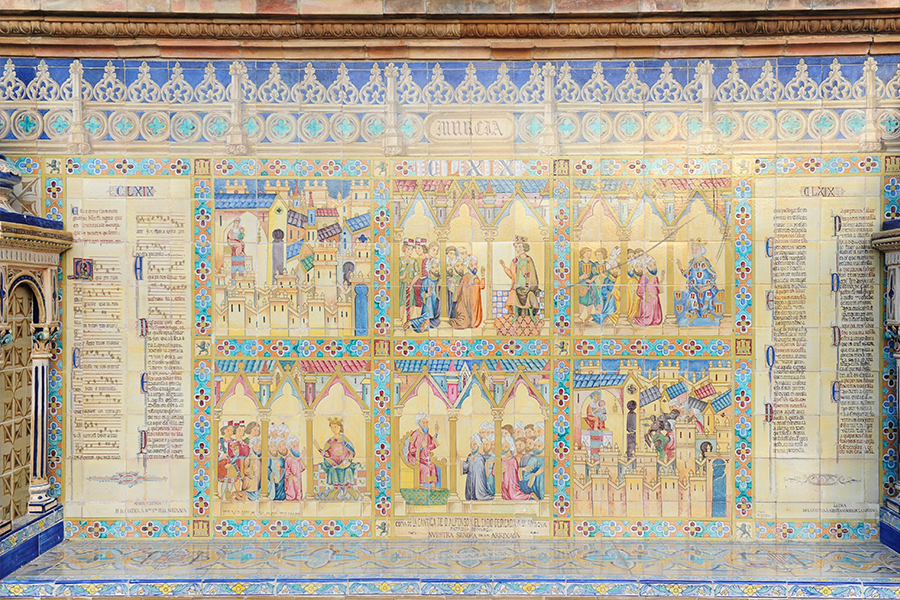
This mural is the alcove dedicated to the province of Murcia. While most alcoves in the plaza feature a single large painting, Murcia’s is unique because it is designed like a medieval manuscript. It illustrates scenes from the Cantigas de Santa María, a famous collection of poems and songs with musical notation compiled during the reign of King Alfonso X "The Wise" in the 13th century. The King had a very close connection to Murcia, and his heart is actually buried in the city's cathedral.

Discovering Azulejos in Everyday Life in Spain

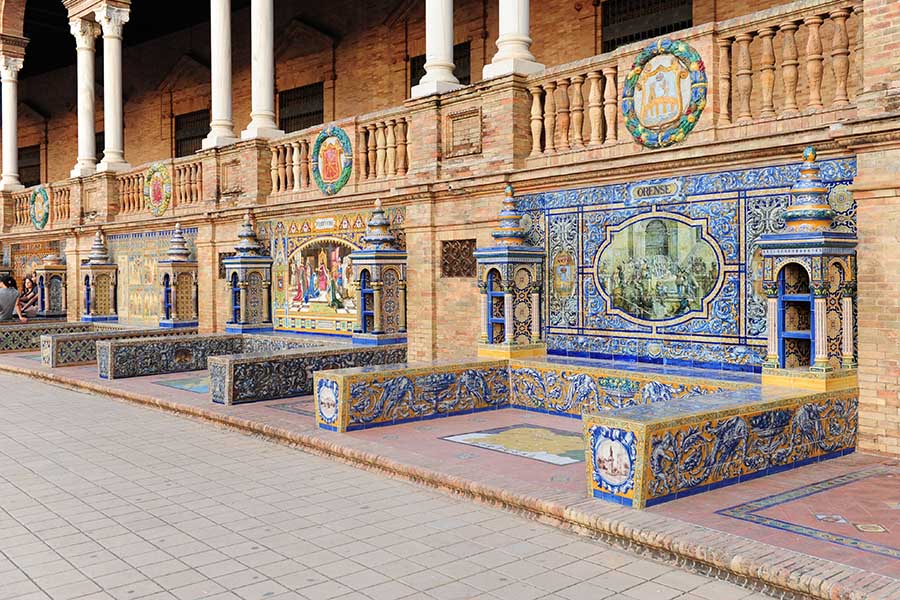
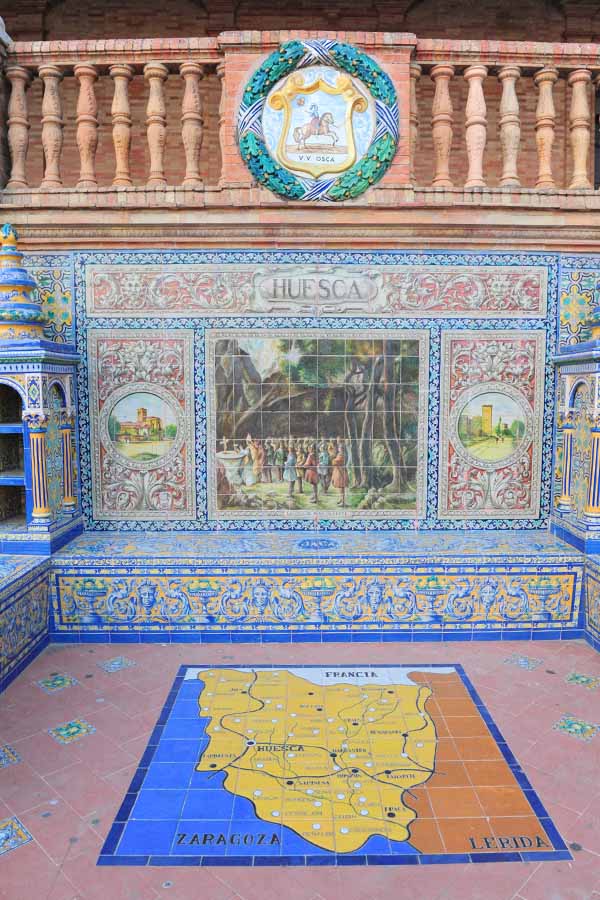
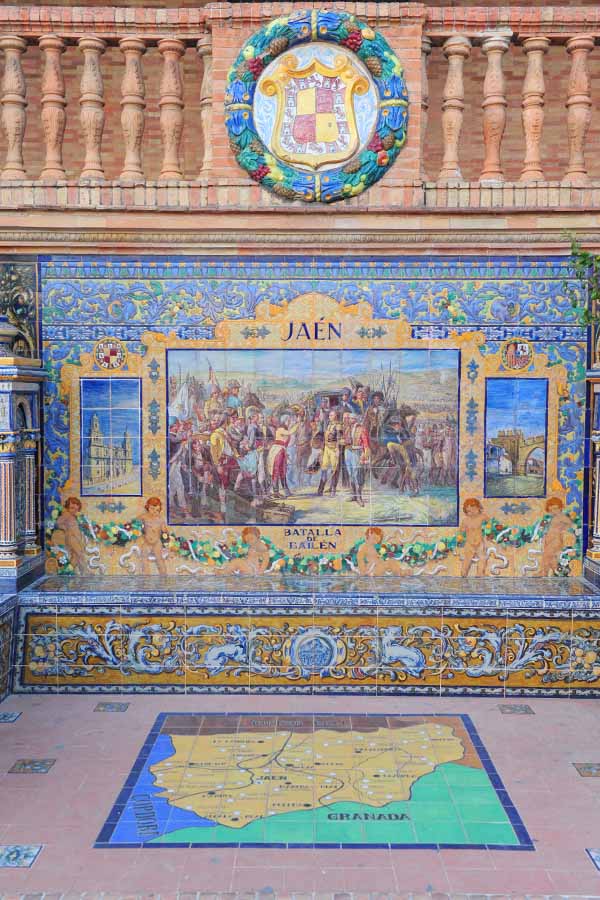
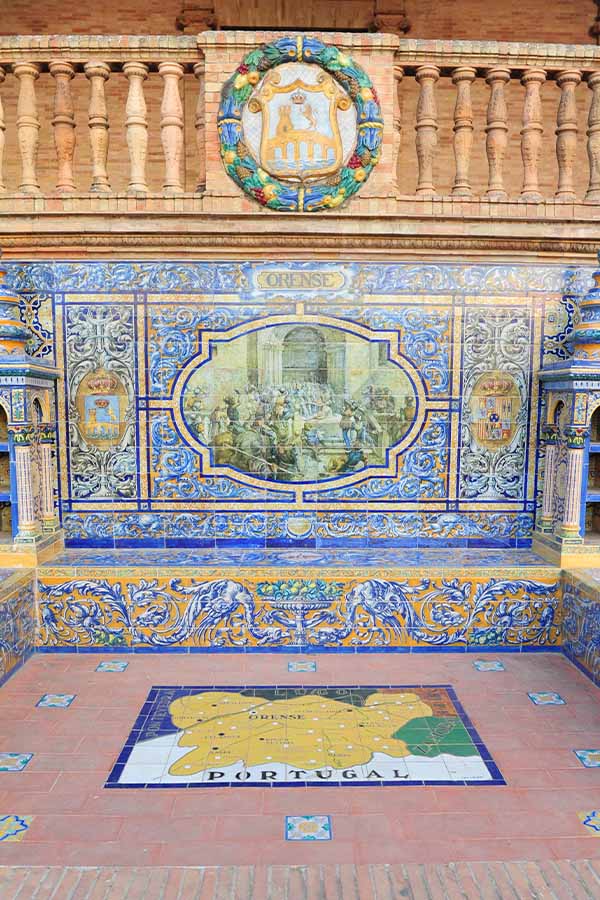
The first time I truly admired these gorgeous tiles was during a solo trip to Seville In Plaza de España where every pattern seemed to lead the eye somewhere new. There, the curved walls are lined with 48 ceramic‑tiled alcoves, each representing a Spanish province with its own map, symbols, and little story captured in color. 

The entire space was created for the Ibero‑American Exposition of 1929 and blends regional pride with artistic expression, the tiles alternately educate, invite rest, and reward curiosity all at once. Following the intricate designs became a personal adventure; each step and glance revealed something different.

seville-plaza-de-la-espana-azulejos
Ornate-tiled-alcove-at-Plaza-de-España-dedicated-to-Huesca-featuring-a-historical-mural-and-tiled-map
art-of-azulejos-seville-spain
azulejos-ceramic-tile-in-seville-spain
fountain-azulejos-tile
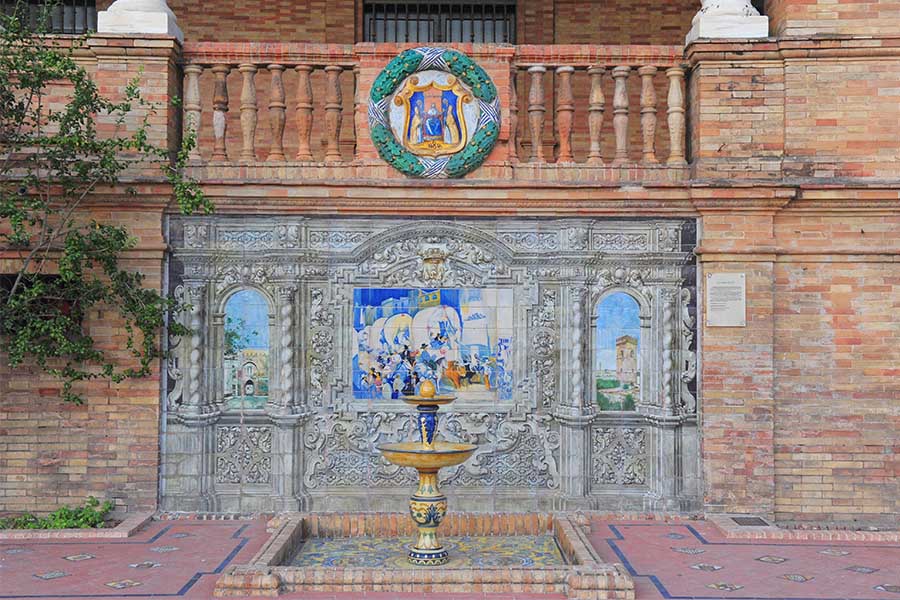
This is the Seville alcove, and since it's the "home" province, it’s much bigger than the others. Unlike the standard benches, it features a built-in ceramic fountain and a larger mural depicting a festive procession of horse-drawn carriages, likely representing the famous Feria de Abril.
Blue-and-white-tiled-stairs-with-a-black-metal-gate-and-lush-green-bushes
door-decorated-with-azulejos-marbella-spain

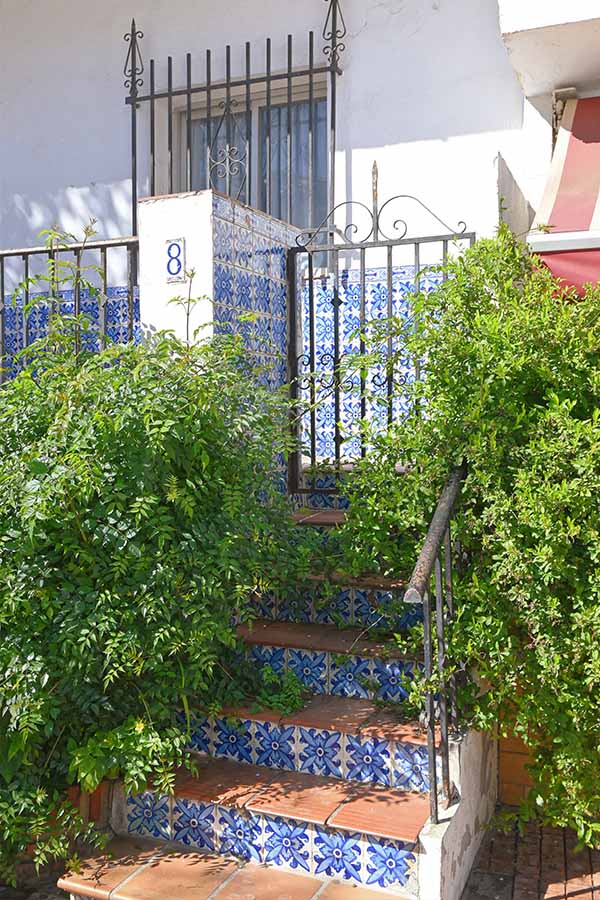
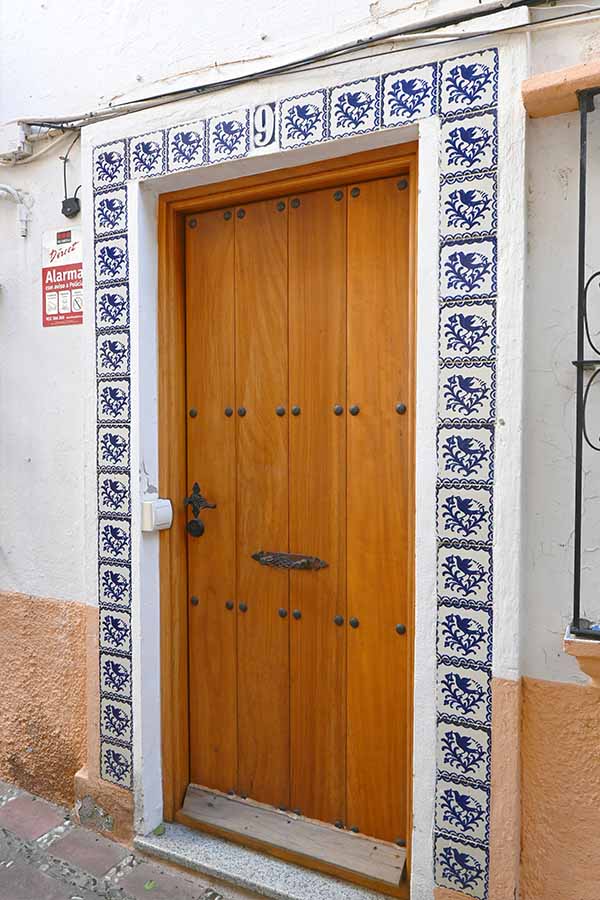
But the magic of azulejos doesn’t stay confined to big plazas, it extends into everyday streets and homes, appearing in subtle corners and unexpected places. Even the simplest azulejos: framing a doorway, lining a staircase, surrounding a window, or decorating a mailbox, quietly shape the personality of a street. 

Once you begin to notice them, your pace shifts. Walking becomes more thoughtful. The town opens up differently when you follow the patterns, textures, and colors woven into its walls. Spain reveals its beauty step by step; its character unfolds gradually, through the details that reward curiosity, inviting you to see each street as its own story.

All images in this article were taken by Elena Sullivan, ArsVie Photo Studio and are protected by copyright. If you are interested in using any of the them, please contact me for permission. Thank you for understanding!

Spain Relocation Quiz

compas-travel

Dreaming of living in Spain? Discover which part of the country fits your rhythm, values, and lifestyle.

TAKE THE QUIZ
TAGS:Azulejosceramic tilecreativityinspirationSpain
0 Comments
Share
Elena Sullivan

Hi, there! I’m Elena Sullivan, a fine art photographer, and creative adventurer. My first joyful experimentation with a camera extended into a passionate relationship where harmony represents a constant flow of elegant devotion. I follow my intuition and curiosity in search of eternal connections in nature, then use my camera to reveal it and share it with you! Every of my photo is curated with love and artistic excellence.
You May Also Like

The Power of Art revealed in Madrid’s Fountain of Cibeles

July 1, 2025

Inside the Bold Hotel Design of citizenM Hotel in Miami South Beach

August 8, 2025

You’re Allowed to Want a More Beautiful Life

January 16, 2026

Leave a Comment Cancel Comment

Previous Post
Falling in Love with Spanish Food in Marbella One Plate at a Time
Next Post
Best Solo Travel Destinations in Mexico for an Unforgettable Trip
hi, I'm Elena
Get To Know Me

Get To Know Me

Hi, I’m Elena, a photographer, creative adventurer, and the voice behind this lifestyle blog. Here you’ll find a mix of colorful style, travel notes, recipes, art, and little joys that make everyday life feel brighter. I love sharing ideas and info that feel both useful and inspiring, always elegant, approachable, and real.

Categories

  • Art & Entertainment
  • City Guides
  • Creativity
  • Food & Dining
  • Gardens
  • Hotels & Restaurant
  • Interior Design
  • Macro photography
  • Monuments & Fountains
  • Museums & Galleries
  • Nostalgic & Vintage
  • Personal Stories
  • Photography
  • Recipes
  • Spain
  • Style & Beauty
  • Travel

Instagram

More of Féria de Malaga #spain #malaga #feriademalaga
•
Follow
More of Féria de Malaga #spain #malaga #feriademalaga
1 day ago
View on Instagram |
1/4
La Feria de Málaga #malaga #spain
•
Follow
La Feria de Málaga #malaga #spain
1 day ago
View on Instagram |
2/4
Almáchar is another little white village tucked away in the hills of La Axarquía, and another place we discovered while exploring the famous Ruta de la Pasa.

Like Moclinejo, this is a village where you quickly realize that the landscape and the local way of life are closely connected to grapes and raisins. Moscatel grapes have been cultivated here for generations, with the traditional production of raisins becoming an important part of the local economy and identity.

Walking through Almáchar, you get that feeling of a place that has grown organically around its landscape - whitewashed houses, narrow streets, steep little corners, and views opening toward the vineyards and hills around the village.

Almáchar also has a small Museo de la Pasa, housed in a traditional two-story home, where you can see the tools and everyday objects connected to the old raisin-making tradition.

Another small corner of Andalusia that reminded me how much there is to discover once you leave the more obvious tourist routes.

#travelphotographer #spain #whitevillage #travelphoto #andalucia
Almáchar is another little white village tucked away in the hills of La Axarquía, and another place we discovered while exploring the famous Ruta de la Pasa.

Like Moclinejo, this is a village where you quickly realize that the landscape and the local way of life are closely connected to grapes and raisins. Moscatel grapes have been cultivated here for generations, with the traditional production of raisins becoming an important part of the local economy and identity.

Walking through Almáchar, you get that feeling of a place that has grown organically around its landscape - whitewashed houses, narrow streets, steep little corners, and views opening toward the vineyards and hills around the village.

Almáchar also has a small Museo de la Pasa, housed in a traditional two-story home, where you can see the tools and everyday objects connected to the old raisin-making tradition.

Another small corner of Andalusia that reminded me how much there is to discover once you leave the more obvious tourist routes.

#travelphotographer #spain #whitevillage #travelphoto #andalucia
Almáchar is another little white village tucked away in the hills of La Axarquía, and another place we discovered while exploring the famous Ruta de la Pasa.

Like Moclinejo, this is a village where you quickly realize that the landscape and the local way of life are closely connected to grapes and raisins. Moscatel grapes have been cultivated here for generations, with the traditional production of raisins becoming an important part of the local economy and identity.

Walking through Almáchar, you get that feeling of a place that has grown organically around its landscape - whitewashed houses, narrow streets, steep little corners, and views opening toward the vineyards and hills around the village.

Almáchar also has a small Museo de la Pasa, housed in a traditional two-story home, where you can see the tools and everyday objects connected to the old raisin-making tradition.

Another small corner of Andalusia that reminded me how much there is to discover once you leave the more obvious tourist routes.

#travelphotographer #spain #whitevillage #travelphoto #andalucia
Almáchar is another little white village tucked away in the hills of La Axarquía, and another place we discovered while exploring the famous Ruta de la Pasa.

Like Moclinejo, this is a village where you quickly realize that the landscape and the local way of life are closely connected to grapes and raisins. Moscatel grapes have been cultivated here for generations, with the traditional production of raisins becoming an important part of the local economy and identity.

Walking through Almáchar, you get that feeling of a place that has grown organically around its landscape - whitewashed houses, narrow streets, steep little corners, and views opening toward the vineyards and hills around the village.

Almáchar also has a small Museo de la Pasa, housed in a traditional two-story home, where you can see the tools and everyday objects connected to the old raisin-making tradition.

Another small corner of Andalusia that reminded me how much there is to discover once you leave the more obvious tourist routes.

#travelphotographer #spain #whitevillage #travelphoto #andalucia
Almáchar is another little white village tucked away in the hills of La Axarquía, and another place we discovered while exploring the famous Ruta de la Pasa.

Like Moclinejo, this is a village where you quickly realize that the landscape and the local way of life are closely connected to grapes and raisins. Moscatel grapes have been cultivated here for generations, with the traditional production of raisins becoming an important part of the local economy and identity.

Walking through Almáchar, you get that feeling of a place that has grown organically around its landscape - whitewashed houses, narrow streets, steep little corners, and views opening toward the vineyards and hills around the village.

Almáchar also has a small Museo de la Pasa, housed in a traditional two-story home, where you can see the tools and everyday objects connected to the old raisin-making tradition.

Another small corner of Andalusia that reminded me how much there is to discover once you leave the more obvious tourist routes.

#travelphotographer #spain #whitevillage #travelphoto #andalucia
Almáchar is another little white village tucked away in the hills of La Axarquía, and another place we discovered while exploring the famous Ruta de la Pasa.

Like Moclinejo, this is a village where you quickly realize that the landscape and the local way of life are closely connected to grapes and raisins. Moscatel grapes have been cultivated here for generations, with the traditional production of raisins becoming an important part of the local economy and identity.

Walking through Almáchar, you get that feeling of a place that has grown organically around its landscape - whitewashed houses, narrow streets, steep little corners, and views opening toward the vineyards and hills around the village.

Almáchar also has a small Museo de la Pasa, housed in a traditional two-story home, where you can see the tools and everyday objects connected to the old raisin-making tradition.

Another small corner of Andalusia that reminded me how much there is to discover once you leave the more obvious tourist routes.

#travelphotographer #spain #whitevillage #travelphoto #andalucia
Almáchar is another little white village tucked away in the hills of La Axarquía, and another place we discovered while exploring the famous Ruta de la Pasa.

Like Moclinejo, this is a village where you quickly realize that the landscape and the local way of life are closely connected to grapes and raisins. Moscatel grapes have been cultivated here for generations, with the traditional production of raisins becoming an important part of the local economy and identity.

Walking through Almáchar, you get that feeling of a place that has grown organically around its landscape - whitewashed houses, narrow streets, steep little corners, and views opening toward the vineyards and hills around the village.

Almáchar also has a small Museo de la Pasa, housed in a traditional two-story home, where you can see the tools and everyday objects connected to the old raisin-making tradition.

Another small corner of Andalusia that reminded me how much there is to discover once you leave the more obvious tourist routes.

#travelphotographer #spain #whitevillage #travelphoto #andalucia
Almáchar is another little white village tucked away in the hills of La Axarquía, and another place we discovered while exploring the famous Ruta de la Pasa.

Like Moclinejo, this is a village where you quickly realize that the landscape and the local way of life are closely connected to grapes and raisins. Moscatel grapes have been cultivated here for generations, with the traditional production of raisins becoming an important part of the local economy and identity.

Walking through Almáchar, you get that feeling of a place that has grown organically around its landscape - whitewashed houses, narrow streets, steep little corners, and views opening toward the vineyards and hills around the village.

Almáchar also has a small Museo de la Pasa, housed in a traditional two-story home, where you can see the tools and everyday objects connected to the old raisin-making tradition.

Another small corner of Andalusia that reminded me how much there is to discover once you leave the more obvious tourist routes.

#travelphotographer #spain #whitevillage #travelphoto #andalucia
Almáchar is another little white village tucked away in the hills of La Axarquía, and another place we discovered while exploring the famous Ruta de la Pasa.

Like Moclinejo, this is a village where you quickly realize that the landscape and the local way of life are closely connected to grapes and raisins. Moscatel grapes have been cultivated here for generations, with the traditional production of raisins becoming an important part of the local economy and identity.

Walking through Almáchar, you get that feeling of a place that has grown organically around its landscape - whitewashed houses, narrow streets, steep little corners, and views opening toward the vineyards and hills around the village.

Almáchar also has a small Museo de la Pasa, housed in a traditional two-story home, where you can see the tools and everyday objects connected to the old raisin-making tradition.

Another small corner of Andalusia that reminded me how much there is to discover once you leave the more obvious tourist routes.

#travelphotographer #spain #whitevillage #travelphoto #andalucia
Almáchar is another little white village tucked away in the hills of La Axarquía, and another place we discovered while exploring the famous Ruta de la Pasa.

Like Moclinejo, this is a village where you quickly realize that the landscape and the local way of life are closely connected to grapes and raisins. Moscatel grapes have been cultivated here for generations, with the traditional production of raisins becoming an important part of the local economy and identity.

Walking through Almáchar, you get that feeling of a place that has grown organically around its landscape - whitewashed houses, narrow streets, steep little corners, and views opening toward the vineyards and hills around the village.

Almáchar also has a small Museo de la Pasa, housed in a traditional two-story home, where you can see the tools and everyday objects connected to the old raisin-making tradition.

Another small corner of Andalusia that reminded me how much there is to discover once you leave the more obvious tourist routes.

#travelphotographer #spain #whitevillage #travelphoto #andalucia
•
Follow
Almáchar is another little white village tucked away in the hills of La Axarquía, and another place we discovered while exploring the famous Ruta de la Pasa. Like Moclinejo, this is a village where you quickly realize that the landscape and the local way of life are closely connected to grapes and raisins. Moscatel grapes have been cultivated here for generations, with the traditional production of raisins becoming an important part of the local economy and identity. Walking through Almáchar, you get that feeling of a place that has grown organically around its landscape - whitewashed houses, narrow streets, steep little corners, and views opening toward the vineyards and hills around the village. Almáchar also has a small Museo de la Pasa, housed in a traditional two-story home, where you can see the tools and everyday objects connected to the old raisin-making tradition. Another small corner of Andalusia that reminded me how much there is to discover once you leave the more obvious tourist routes. #travelphotographer #spain #whitevillage #travelphoto #andalucia
1 day ago
View on Instagram |
3/4
After experiencing it for many years, I think when you live a creative lifestyle, which might involve running a small business, being an artist, or a freelancer or working as a solo entrepreneur, your work life can start to feel like one never-ending experiment.
You keep adding new services to your business, new ideas to your to-do list, all with the goal of reaching new heights — more ROI, more clients, more exposure.
And if one adjustment or idea doesn’t work, you try another one, and then another. And this circle just keeps going, so sometimes it feels like you’re constantly experimenting with your own business.
I think that’s partly because, as creative people, our minds are constantly searching. We’re open to new things, so we can come up with dozens of new ideas every day, or at least every week.
After many years of running my own creative ventures, there is something I had to learn from all these experiments….
The challenge is actually to limit yourself, stay focused, and allow time to do its work.
Because sometimes you have an idea that could actually work but you don’t give it enough time. You change it, add something new, try something else, and before you know it, you’re starting another experiment.
So guys, if you’re thinking about starting some new creative venture, stay focused and give it time. And by time, I mean more than a year, more than two years, maybe even three. I know it’s difficult when you’re excited about new ideas all the time. But sometimes the best thing you can do for your idea is simply give it enough time to grow. #travel #creative #creativebusiness #creativecommunity #travelphotographer
•
Follow
After experiencing it for many years, I think when you live a creative lifestyle, which might involve running a small business, being an artist, or a freelancer or working as a solo entrepreneur, your work life can start to feel like one never-ending experiment. You keep adding new services to your business, new ideas to your to-do list, all with the goal of reaching new heights — more ROI, more clients, more exposure. And if one adjustment or idea doesn’t work, you try another one, and then another. And this circle just keeps going, so sometimes it feels like you’re constantly experimenting with your own business. I think that’s partly because, as creative people, our minds are constantly searching. We’re open to new things, so we can come up with dozens of new ideas every day, or at least every week. After many years of running my own creative ventures, there is something I had to learn from all these experiments…. The challenge is actually to limit yourself, stay focused, and allow time to do its work. Because sometimes you have an idea that could actually work but you don’t give it enough time. You change it, add something new, try something else, and before you know it, you’re starting another experiment. So guys, if you’re thinking about starting some new creative venture, stay focused and give it time. And by time, I mean more than a year, more than two years, maybe even three. I know it’s difficult when you’re excited about new ideas all the time. But sometimes the best thing you can do for your idea is simply give it enough time to grow. #travel #creative #creativebusiness #creativecommunity #travelphotographer
4 days ago
View on Instagram |
4/4
@elenasullivanphotographer
Current Location

Current Location

Malaga, Spain

How traveling solo with a one-way ticket changed my life? My personal story.

How traveling solo with a one-way ticket changed my life? My personal story. How traveling solo with a one-way ticket changed my life? My personal story.

Find inspiration to fuel your creativity and embrace exploration. Encounter challenges, relish in fun moments, make courageous discoveries, with a sprinkle of some romantic stories along the way.

Enjoy Reading
What I'm Loving

Shop My Current Faves

product_title_1

Nikon D750 body

product_title_2

Nikon AF-S VR Micro-NIKKOR 105mm f/2.8G

product_title_3

Ikelite 200DL Underwater Housing for Nikon D750 with Dry Lock Port Mount

product_title_4

The Art of Photography: A Personal Approach to Artistic Expression

Caribbean Vibes

Commercial Photography

Flying Dress

Learn Photography Online

Photo Consultations

my favorites

Where I Shop

B&H Photo Video

Etsy

Amazon

Creative Market

Pix&Hue

SHEIN

The Latest Video

The Latest Video The Latest Video

Inspiration, creative adventures, aesthetic elegance, joy, and more on my YouTube channel; join to stay updated.

Subscribe to My Channel

Ready to receive postcards of inspiration?

Get ready to be inspired! Subscribe to my newsletter for exclusive updates, captivating images, and behind-the-scenes stories. Join me on this creative journey!

Sign me up!

Follow Along With Me

More of Féria de Malaga #spain #malaga #feriademalaga
•
Follow
More of Féria de Malaga #spain #malaga #feriademalaga
1 day ago
View on Instagram |
1/5
La Feria de Málaga #malaga #spain
•
Follow
La Feria de Málaga #malaga #spain
1 day ago
View on Instagram |
2/5
Almáchar is another little white village tucked away in the hills of La Axarquía, and another place we discovered while exploring the famous Ruta de la Pasa.

Like Moclinejo, this is a village where you quickly realize that the landscape and the local way of life are closely connected to grapes and raisins. Moscatel grapes have been cultivated here for generations, with the traditional production of raisins becoming an important part of the local economy and identity.

Walking through Almáchar, you get that feeling of a place that has grown organically around its landscape - whitewashed houses, narrow streets, steep little corners, and views opening toward the vineyards and hills around the village.

Almáchar also has a small Museo de la Pasa, housed in a traditional two-story home, where you can see the tools and everyday objects connected to the old raisin-making tradition.

Another small corner of Andalusia that reminded me how much there is to discover once you leave the more obvious tourist routes.

#travelphotographer #spain #whitevillage #travelphoto #andalucia
Almáchar is another little white village tucked away in the hills of La Axarquía, and another place we discovered while exploring the famous Ruta de la Pasa.

Like Moclinejo, this is a village where you quickly realize that the landscape and the local way of life are closely connected to grapes and raisins. Moscatel grapes have been cultivated here for generations, with the traditional production of raisins becoming an important part of the local economy and identity.

Walking through Almáchar, you get that feeling of a place that has grown organically around its landscape - whitewashed houses, narrow streets, steep little corners, and views opening toward the vineyards and hills around the village.

Almáchar also has a small Museo de la Pasa, housed in a traditional two-story home, where you can see the tools and everyday objects connected to the old raisin-making tradition.

Another small corner of Andalusia that reminded me how much there is to discover once you leave the more obvious tourist routes.

#travelphotographer #spain #whitevillage #travelphoto #andalucia
Almáchar is another little white village tucked away in the hills of La Axarquía, and another place we discovered while exploring the famous Ruta de la Pasa.

Like Moclinejo, this is a village where you quickly realize that the landscape and the local way of life are closely connected to grapes and raisins. Moscatel grapes have been cultivated here for generations, with the traditional production of raisins becoming an important part of the local economy and identity.

Walking through Almáchar, you get that feeling of a place that has grown organically around its landscape - whitewashed houses, narrow streets, steep little corners, and views opening toward the vineyards and hills around the village.

Almáchar also has a small Museo de la Pasa, housed in a traditional two-story home, where you can see the tools and everyday objects connected to the old raisin-making tradition.

Another small corner of Andalusia that reminded me how much there is to discover once you leave the more obvious tourist routes.

#travelphotographer #spain #whitevillage #travelphoto #andalucia
Almáchar is another little white village tucked away in the hills of La Axarquía, and another place we discovered while exploring the famous Ruta de la Pasa.

Like Moclinejo, this is a village where you quickly realize that the landscape and the local way of life are closely connected to grapes and raisins. Moscatel grapes have been cultivated here for generations, with the traditional production of raisins becoming an important part of the local economy and identity.

Walking through Almáchar, you get that feeling of a place that has grown organically around its landscape - whitewashed houses, narrow streets, steep little corners, and views opening toward the vineyards and hills around the village.

Almáchar also has a small Museo de la Pasa, housed in a traditional two-story home, where you can see the tools and everyday objects connected to the old raisin-making tradition.

Another small corner of Andalusia that reminded me how much there is to discover once you leave the more obvious tourist routes.

#travelphotographer #spain #whitevillage #travelphoto #andalucia
Almáchar is another little white village tucked away in the hills of La Axarquía, and another place we discovered while exploring the famous Ruta de la Pasa.

Like Moclinejo, this is a village where you quickly realize that the landscape and the local way of life are closely connected to grapes and raisins. Moscatel grapes have been cultivated here for generations, with the traditional production of raisins becoming an important part of the local economy and identity.

Walking through Almáchar, you get that feeling of a place that has grown organically around its landscape - whitewashed houses, narrow streets, steep little corners, and views opening toward the vineyards and hills around the village.

Almáchar also has a small Museo de la Pasa, housed in a traditional two-story home, where you can see the tools and everyday objects connected to the old raisin-making tradition.

Another small corner of Andalusia that reminded me how much there is to discover once you leave the more obvious tourist routes.

#travelphotographer #spain #whitevillage #travelphoto #andalucia
Almáchar is another little white village tucked away in the hills of La Axarquía, and another place we discovered while exploring the famous Ruta de la Pasa.

Like Moclinejo, this is a village where you quickly realize that the landscape and the local way of life are closely connected to grapes and raisins. Moscatel grapes have been cultivated here for generations, with the traditional production of raisins becoming an important part of the local economy and identity.

Walking through Almáchar, you get that feeling of a place that has grown organically around its landscape - whitewashed houses, narrow streets, steep little corners, and views opening toward the vineyards and hills around the village.

Almáchar also has a small Museo de la Pasa, housed in a traditional two-story home, where you can see the tools and everyday objects connected to the old raisin-making tradition.

Another small corner of Andalusia that reminded me how much there is to discover once you leave the more obvious tourist routes.

#travelphotographer #spain #whitevillage #travelphoto #andalucia
Almáchar is another little white village tucked away in the hills of La Axarquía, and another place we discovered while exploring the famous Ruta de la Pasa.

Like Moclinejo, this is a village where you quickly realize that the landscape and the local way of life are closely connected to grapes and raisins. Moscatel grapes have been cultivated here for generations, with the traditional production of raisins becoming an important part of the local economy and identity.

Walking through Almáchar, you get that feeling of a place that has grown organically around its landscape - whitewashed houses, narrow streets, steep little corners, and views opening toward the vineyards and hills around the village.

Almáchar also has a small Museo de la Pasa, housed in a traditional two-story home, where you can see the tools and everyday objects connected to the old raisin-making tradition.

Another small corner of Andalusia that reminded me how much there is to discover once you leave the more obvious tourist routes.

#travelphotographer #spain #whitevillage #travelphoto #andalucia
Almáchar is another little white village tucked away in the hills of La Axarquía, and another place we discovered while exploring the famous Ruta de la Pasa.

Like Moclinejo, this is a village where you quickly realize that the landscape and the local way of life are closely connected to grapes and raisins. Moscatel grapes have been cultivated here for generations, with the traditional production of raisins becoming an important part of the local economy and identity.

Walking through Almáchar, you get that feeling of a place that has grown organically around its landscape - whitewashed houses, narrow streets, steep little corners, and views opening toward the vineyards and hills around the village.

Almáchar also has a small Museo de la Pasa, housed in a traditional two-story home, where you can see the tools and everyday objects connected to the old raisin-making tradition.

Another small corner of Andalusia that reminded me how much there is to discover once you leave the more obvious tourist routes.

#travelphotographer #spain #whitevillage #travelphoto #andalucia
Almáchar is another little white village tucked away in the hills of La Axarquía, and another place we discovered while exploring the famous Ruta de la Pasa.

Like Moclinejo, this is a village where you quickly realize that the landscape and the local way of life are closely connected to grapes and raisins. Moscatel grapes have been cultivated here for generations, with the traditional production of raisins becoming an important part of the local economy and identity.

Walking through Almáchar, you get that feeling of a place that has grown organically around its landscape - whitewashed houses, narrow streets, steep little corners, and views opening toward the vineyards and hills around the village.

Almáchar also has a small Museo de la Pasa, housed in a traditional two-story home, where you can see the tools and everyday objects connected to the old raisin-making tradition.

Another small corner of Andalusia that reminded me how much there is to discover once you leave the more obvious tourist routes.

#travelphotographer #spain #whitevillage #travelphoto #andalucia
Almáchar is another little white village tucked away in the hills of La Axarquía, and another place we discovered while exploring the famous Ruta de la Pasa.

Like Moclinejo, this is a village where you quickly realize that the landscape and the local way of life are closely connected to grapes and raisins. Moscatel grapes have been cultivated here for generations, with the traditional production of raisins becoming an important part of the local economy and identity.

Walking through Almáchar, you get that feeling of a place that has grown organically around its landscape - whitewashed houses, narrow streets, steep little corners, and views opening toward the vineyards and hills around the village.

Almáchar also has a small Museo de la Pasa, housed in a traditional two-story home, where you can see the tools and everyday objects connected to the old raisin-making tradition.

Another small corner of Andalusia that reminded me how much there is to discover once you leave the more obvious tourist routes.

#travelphotographer #spain #whitevillage #travelphoto #andalucia
•
Follow
Almáchar is another little white village tucked away in the hills of La Axarquía, and another place we discovered while exploring the famous Ruta de la Pasa. Like Moclinejo, this is a village where you quickly realize that the landscape and the local way of life are closely connected to grapes and raisins. Moscatel grapes have been cultivated here for generations, with the traditional production of raisins becoming an important part of the local economy and identity. Walking through Almáchar, you get that feeling of a place that has grown organically around its landscape - whitewashed houses, narrow streets, steep little corners, and views opening toward the vineyards and hills around the village. Almáchar also has a small Museo de la Pasa, housed in a traditional two-story home, where you can see the tools and everyday objects connected to the old raisin-making tradition. Another small corner of Andalusia that reminded me how much there is to discover once you leave the more obvious tourist routes. #travelphotographer #spain #whitevillage #travelphoto #andalucia
1 day ago
View on Instagram |
3/5
After experiencing it for many years, I think when you live a creative lifestyle, which might involve running a small business, being an artist, or a freelancer or working as a solo entrepreneur, your work life can start to feel like one never-ending experiment.
You keep adding new services to your business, new ideas to your to-do list, all with the goal of reaching new heights — more ROI, more clients, more exposure.
And if one adjustment or idea doesn’t work, you try another one, and then another. And this circle just keeps going, so sometimes it feels like you’re constantly experimenting with your own business.
I think that’s partly because, as creative people, our minds are constantly searching. We’re open to new things, so we can come up with dozens of new ideas every day, or at least every week.
After many years of running my own creative ventures, there is something I had to learn from all these experiments….
The challenge is actually to limit yourself, stay focused, and allow time to do its work.
Because sometimes you have an idea that could actually work but you don’t give it enough time. You change it, add something new, try something else, and before you know it, you’re starting another experiment.
So guys, if you’re thinking about starting some new creative venture, stay focused and give it time. And by time, I mean more than a year, more than two years, maybe even three. I know it’s difficult when you’re excited about new ideas all the time. But sometimes the best thing you can do for your idea is simply give it enough time to grow. #travel #creative #creativebusiness #creativecommunity #travelphotographer
•
Follow
After experiencing it for many years, I think when you live a creative lifestyle, which might involve running a small business, being an artist, or a freelancer or working as a solo entrepreneur, your work life can start to feel like one never-ending experiment. You keep adding new services to your business, new ideas to your to-do list, all with the goal of reaching new heights — more ROI, more clients, more exposure. And if one adjustment or idea doesn’t work, you try another one, and then another. And this circle just keeps going, so sometimes it feels like you’re constantly experimenting with your own business. I think that’s partly because, as creative people, our minds are constantly searching. We’re open to new things, so we can come up with dozens of new ideas every day, or at least every week. After many years of running my own creative ventures, there is something I had to learn from all these experiments…. The challenge is actually to limit yourself, stay focused, and allow time to do its work. Because sometimes you have an idea that could actually work but you don’t give it enough time. You change it, add something new, try something else, and before you know it, you’re starting another experiment. So guys, if you’re thinking about starting some new creative venture, stay focused and give it time. And by time, I mean more than a year, more than two years, maybe even three. I know it’s difficult when you’re excited about new ideas all the time. But sometimes the best thing you can do for your idea is simply give it enough time to grow. #travel #creative #creativebusiness #creativecommunity #travelphotographer
4 days ago
View on Instagram |
4/5
Tucked away in the mountain ranges of Piedras Blancas and Cerros de Córdoba, Moclinejo is one of those little hidden gems of Andalusia that you might easily miss.
We came here without really knowing what to expect, and I think that’s part of what made discovering it so wonderful.
It’s one of the small white towns of Andalusia where you can simply enjoy walking around and noticing little details — the whitewashed houses, narrow streets, flowers, doors, and especially the colorful ceramics that have become such an important part of the street decoration here. You see them everywhere, adding color and personality to the white walls and giving this town a very distinctive character.
And let’s not forget the grapes and raisins.
They are important local products here. The tradition of growing Moscatel grapes and producing raisins has shaped the lifestyle and economy of the area for generations, and you can still feel that connection when you walk through the town.
I love discovering places like Moclinejo because in this type of town, you don’t need a famous landmark or a big tourist attraction to feel connected to a place.
Very often, it’s the streets, the houses, the ceramics, the little details, and the stories of people behind them that make a place memorable. If you are ever traveling in Andalusia, make sure to stop by Moclinejo and wander through its streets.
#travel #spain #andalucia #history #art
•
Follow
Tucked away in the mountain ranges of Piedras Blancas and Cerros de Córdoba, Moclinejo is one of those little hidden gems of Andalusia that you might easily miss. We came here without really knowing what to expect, and I think that’s part of what made discovering it so wonderful. It’s one of the small white towns of Andalusia where you can simply enjoy walking around and noticing little details — the whitewashed houses, narrow streets, flowers, doors, and especially the colorful ceramics that have become such an important part of the street decoration here. You see them everywhere, adding color and personality to the white walls and giving this town a very distinctive character. And let’s not forget the grapes and raisins. They are important local products here. The tradition of growing Moscatel grapes and producing raisins has shaped the lifestyle and economy of the area for generations, and you can still feel that connection when you walk through the town. I love discovering places like Moclinejo because in this type of town, you don’t need a famous landmark or a big tourist attraction to feel connected to a place. Very often, it’s the streets, the houses, the ceramics, the little details, and the stories of people behind them that make a place memorable. If you are ever traveling in Andalusia, make sure to stop by Moclinejo and wander through its streets. #travel #spain #andalucia #history #art
6 days ago
View on Instagram |
5/5
@elenasullivanphotographer
  • Home
  • About
  • Gallery
  • Blog
  • Privacy Policy
  • Terms and Conditions
  • Shipping Info
  • Return Policy
  • Photo Classes
  • Contact

Copyright © 2026 Elena Sullivan Fine Art Photography. All Rights Reserved. Site Powered by Pix & Hue.